States and elections
Wira Bandar PC is a fork of OpenTTD: OpenTTD's code with changes, free software under the GNU GPL v2. About and credits
Towns are grouped into states, as in Malaysia, and every five years each state elects an assembly and the country a parliament. Voters judge only the service they get in their town, and the winning platform (three made-up ones, no real parties) changes how the state’s towns spend, grow and price their land. Your company can’t stand, campaign or pay anyone: only the service it runs moves votes.
Open the States window
Section titled “Open the States window”- On the main toolbar, click Towns (the houses icon; tooltip Open town directory or found town) and choose States. The States and federal territories window opens. You can also click State in any town window to open it with that town’s state selected.
- Click a state in the list to see its details below. Double-click it, or click Go to capital, to centre the main view on its capital.
- Click Map of states to see the states on the map. Rename gives the selected state a name of your own (in a network game only the server can).
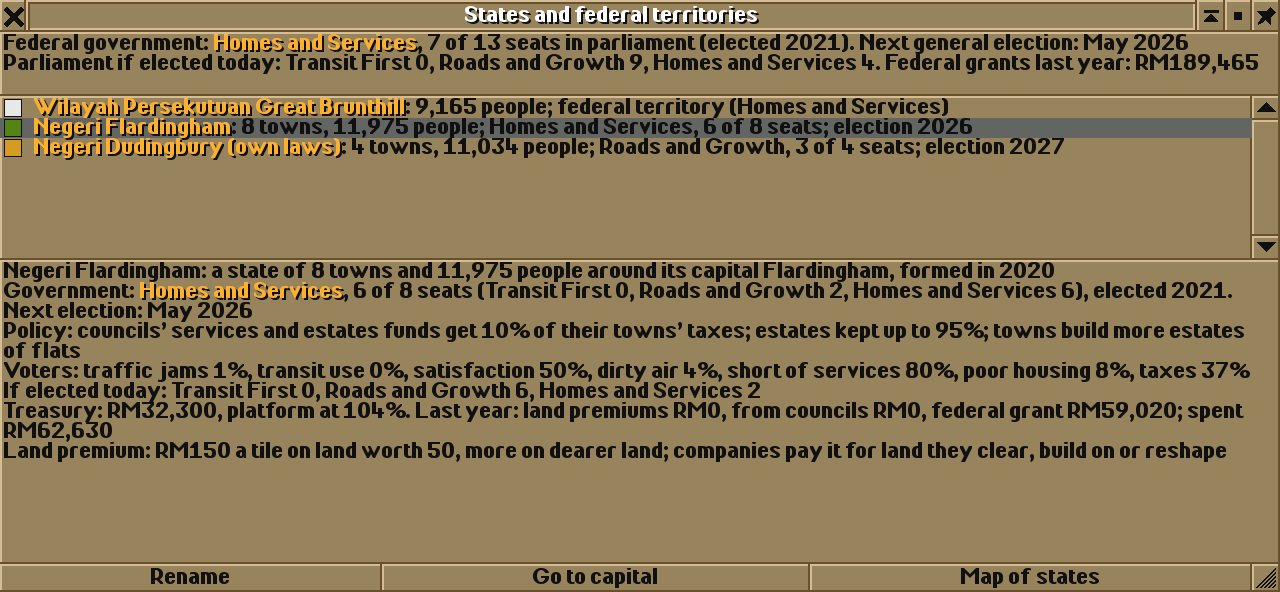
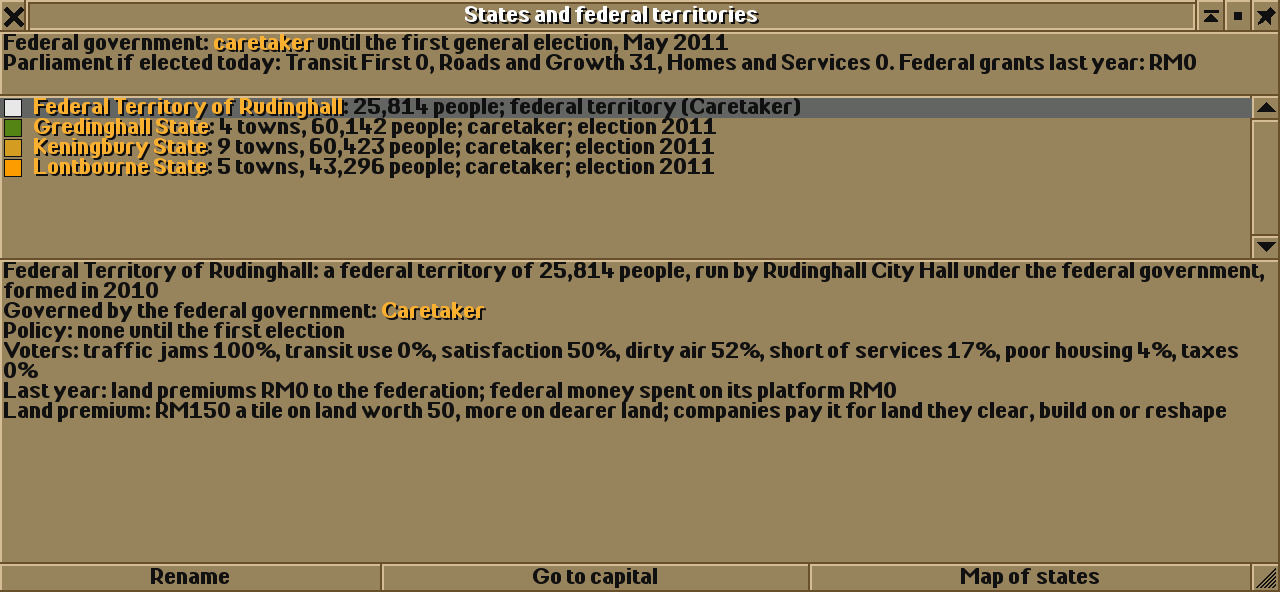
At the top are the federal government and parliament; the list gives each state’s towns, people, government, seats and next election. Below, the selected state’s government, Policy:, Voters:, the seats if elected today, its treasury and its Land premium:. Town windows have a State: line too.
How the states form
Section titled “How the states form”The states form when the first new month begins, in a new game and in an older save alike (until then the window says The states are formed at the start of the next month).
- Lands. Land joined by land is one land. The sea splits lands, and so does a neck of land at most 8 tiles wide (16 on maps over 256 tiles across, 24 over 1,024), where a land border runs. The main land is the one with the most people.
- Federal territory. The biggest town on the main land becomes a federal territory, run by its City Hall; big maps get a second one. See federal territories and regions.
- Capitals. The biggest towns, spread over the land, become state capitals: about one for every six towns, at most 13 on the main land and 3 in a region. A state is named after its capital: Negeri Flardingham, or Flardingham State in English.
- Every other town joins the nearest capital on its land (island towns the nearest state across the sea); new towns join the state whose land they are on.
- Regions. Another land with two towns or more, big enough, is a region run like Sabah and Sarawak, with states of its own (see regions).
If a capital disappears, the biggest town left in the state becomes its capital; a state with no towns left is dissolved.
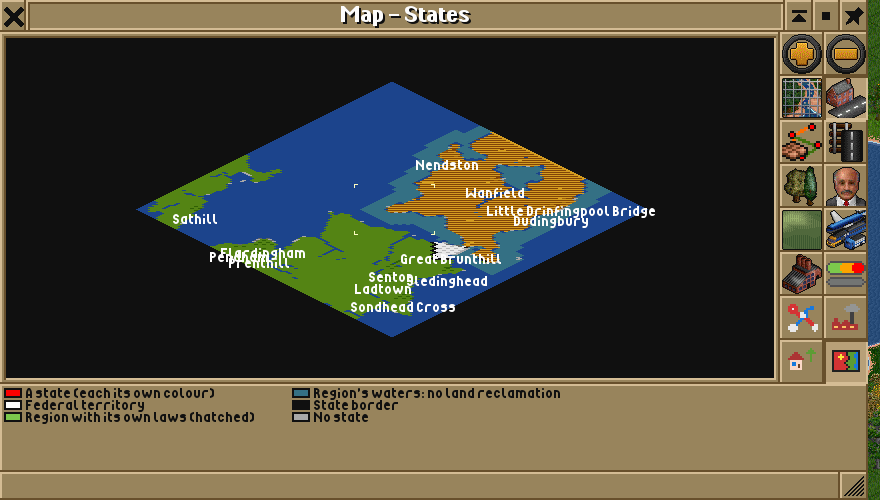
To see it, click Map of states in the States window, or open the map (main toolbar Map, the map icon, tooltip Open map, extra viewport, cargo flow or list of signs, then Map of world, or press F4) and click its States button (tooltip Show the states and federal territories on the map, and the waters of regions run like Sabah and Sarawak). Every bit of land belongs to the state of the nearest town along the land. Federal territories are white, regions are hatched, a region’s waters have their own colour, and borders are black.
Elections
Section titled “Elections”- Seats. Every town has a seat, and one more for each 10,000 people.
- State assemblies are elected every five years. The platform with the most seats governs; on a tie the platform already in power keeps it.
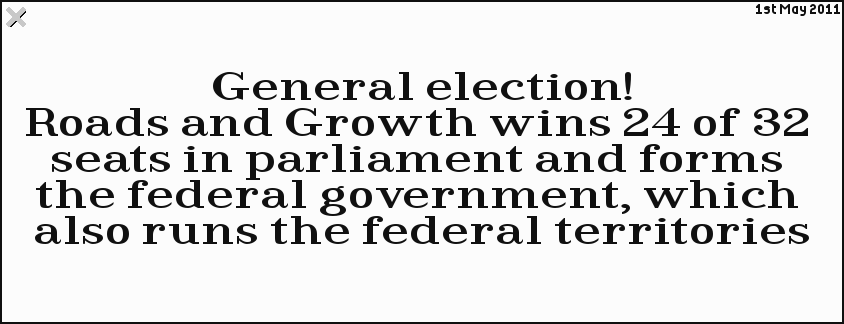
- General elections are held in May: parliament (every town’s seats) and the assemblies of the states on the main land. The platform with the most seats in parliament forms the federal government, which also runs the federal territories.
- Regions elect their assemblies on their own, in September.
- The first general election is in May of the year after the states form, the regions’ a year later. Until then each government is a caretaker, which spends nothing on a platform.
Each election brings news, such as Negeri Gredinghall votes: Transit First wins 9 of 9 seats and forms the state government.
What voters judge
Section titled “What voters judge”The Voters: line shows how much each concern weighs with the state’s voters, from 0% to 100%: traffic jams, transit use, satisfaction, dirty air, short of services, poor housing and taxes. Small towns also want to grow. Each town votes on its own numbers, and each seat goes to the platform that appeals most to it, give or take a little chance:
| Platform | Appeals to |
|---|---|
| Transit First | people who ride transit (35%) and are satisfied with it (20%), drivers stuck in traffic jams (25%), people breathing dirty air (20%) |
| Roads and Growth | people who drive (35%), drivers stuck in traffic jams (30%), small towns that want to grow (20%), people paying high taxes (15%) |
| Homes and Services | people short of city services (45%), people in run-down estates of flats (35%), people paying high taxes (20%) |
A government whose voters rate their service better than at its election gains up to 10 points in every seat; one that made things worse loses them. If elected today shows the seats each platform would win now, without the chance. The tutorial Win a Transit First state shows how each concern is measured.
What each platform does
Section titled “What each platform does”A government spends a tenth of its towns’ taxes a year on its platform (its federal grant); with money to spare in its treasury it does up to twice as much. Policy: shows what it does and how strongly.
| Platform | What it does |
|---|---|
| Transit First | each town’s transit budget gets 10% of its taxes on top (up to 20%), for more contracts, free lines and passes; towns are readier to bring in a transit fund, a car-free centre, transit-oriented development, parking limits and low-emission zones |
| Roads and Growth | towns grow 15% faster (up to 30%); land premiums are halved; each quarter one town in turn gets three months of funded new buildings; towns are slower to limit cars |
| Homes and Services | the councils’ services and estates funds get 10% of their towns’ taxes (up to 20%); estates are kept up to 95% instead of 85%; towns build estates of flats half again as readily |
A state’s money
Section titled “A state’s money”- Federal grant: a tenth of its towns’ taxes a year, paid monthly into its treasury.
- Levies: each January a state takes a third of what a council keeps beyond two years’ taxes, the reserves rich cities pile up.
- Land premiums: states hold the land. A company pays a premium for each tile of land (grass, rough land, fields, trees or a house) it clears, builds on or reshapes. The Land premium: line gives the price on land worth 50; dearer land costs more (up to twice that), cheap land much less. Regions charge twice as much, and Roads and Growth halves it.
- The treasury keeps six months of the grant. Money beyond that makes the platform stronger, up to double (platform at 200%) with a year’s grant to spare. A caretaker’s treasury fills up, so a new government often starts at full strength.
Names in Malay or English
Section titled “Names in Malay or English”With Council and state names set to English (see town councils), Negeri Gredinghall reads Gredinghall State and Wilayah Persekutuan Rudinghall reads Federal Territory of Rudinghall, run by Rudinghall City Hall.
- Seats follow people: one big city can outvote several villages.
- Clearing land costs a premium on top of the usual price, more in city centres. Plan long lines over cheap land, or wait for a Roads and Growth government.
Switching it off
Section titled “Switching it off”SettingStates and elections
Main toolbar: Options and settings (the gear) → Game options → Advanced tab → Environment → Towns. Or type its name in the Filter box.
Choices: On, Off. Default: On. Choose Off for the game as in OpenTTD.
States need Town councils and Town budgets and ordinances. With states off there are no elections, platforms, land premiums, federal territories or regions.
See also
Section titled “See also”Wira Bandar PC is a fork of OpenTTD. It is OpenTTD's code with changes, not a game made from scratch. OpenTTD is made by the OpenTTD team and contributors and is free software under theGNU General Public License version 2; Wira Bandar PC keeps that licence, OpenTTD's credits and copyright notices.Source code ·OpenTTD ·About and credits
Wira Bandar PC is not made or supported by the OpenTTD team, so please don't report its bugs to OpenTTD (see FAQ and troubleshooting).