
Expressways, tolls and congestion charges
Wira Bandar PC is a fork of OpenTTD: OpenTTD's code with changes, free software under the GNU GPL v2. About and credits
Expressways are fast roads for through traffic, kept free of houses and level crossings. A toll plaza on your expressway earns money from the town traffic between the towns it links and from other companies’ road vehicles, as a concession like Malaysia’s highways. Congestion charges work the other way round: a town charges cars to drive into its centre, its streets get quieter and the money goes to its transit budget.
Build an expressway
Section titled “Build an expressway”- On the main toolbar, click Build roads (the road icon; tooltip Build road infrastructure) and choose Expressway construction.
- The Expressway Construction toolbar works like the road toolbar: build road sections, bridges and tunnels.
- To upgrade one of your own roads, use its convert tool (tooltip Convert/Upgrade the type of road). Town roads can’t be converted.
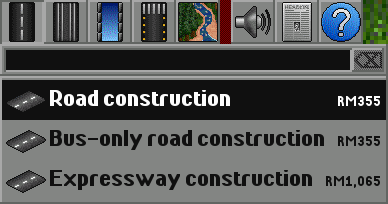
- Towns don’t build expressways, and no houses grow along them.
- Railways can’t cross them on the level: they go over on bridges or under in tunnels.
- An expressway costs three times as much as road to build and twice as much to maintain, and has no speed limit.
- Any road vehicle that can use ordinary road can drive on it, and it carries two and a half times the town traffic of a town road before it congests.
- On straight, flat stretches it is drawn with two lanes each way, edge lines and a barrier in the middle.
Build a toll plaza
Section titled “Build a toll plaza”- Open the road toolbar (Shift+F8) and click the tolls button (a toll barrier; tooltip Tolls: toll plazas on your expressways, free-flow gantries and your toll prices), or press K. The Tolls toolbar opens with three buttons (keys 1 to 3).
- Click the toll plaza button (1), then a straight stretch of your own expressway.
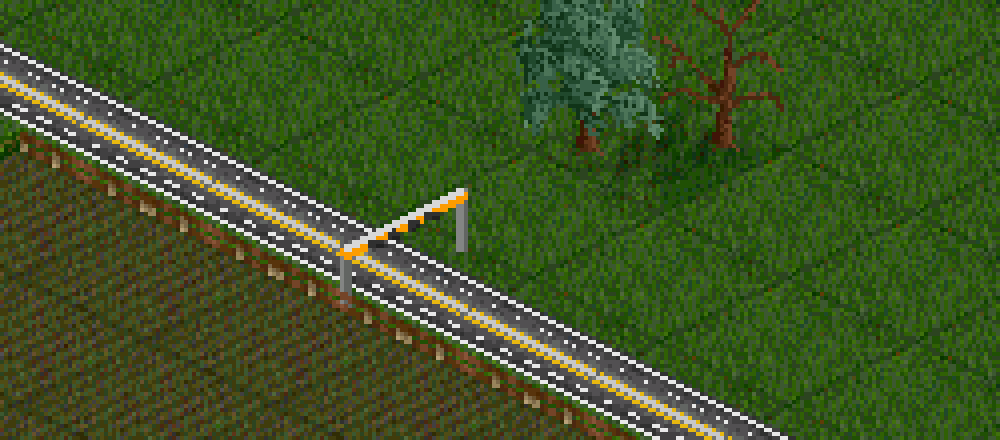
- To swap the booths for a free-flow gantry, click the free-flow button (2), then the plaza.
- To remove a plaza, Ctrl+click it with the toll plaza tool.
Plazas only go on straight stretches of an expressway you own (… toll plazas go on straight stretches of your expressways), not on town roads. Each has a yearly upkeep.
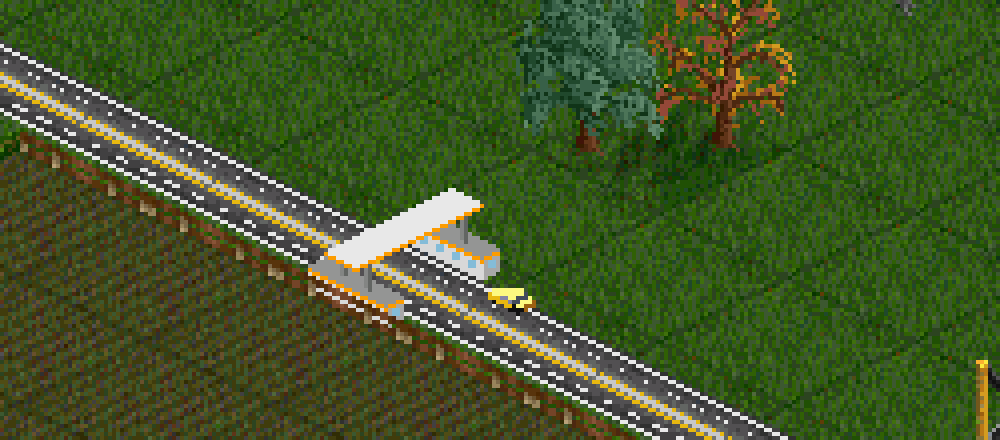
Where the tolls come from
Section titled “Where the tolls come from”- Town traffic. Each month the game follows your expressway from the plaza, through its bridges and tunnels, to the roads that join it. Each joining road counts for the closest town within 32 tiles. Each pair of towns linked this way makes trips: more the bigger both towns are, fewer the further apart they are. Two towns of 10,000 people 40 tiles apart make about 20 trips a month, each standing for many cars. A trip pays the standard toll for every 40 tiles between the towns (Per km (closed system)) or once (Flat (open system)), plus a tenth for the mix of cars, motorbikes and lorries. An expressway with several plazas is paid once, and the figures are shared out over its plazas.
- Other companies’ road vehicles pay at every plaza they pass: buses three quarters of the standard toll, mail vans the standard toll and lorries twice that, like Malaysia’s toll classes. It is booked as their running costs and as your income.
Everyone slows to 20 km/h at the booths. Swapping them for a free-flow gantry costs two thirds of what the plaza cost, and the gantry costs less than half as much a year to run. Nobody slows down, and when every plaza on the expressway is free-flow, 10% more trips use it.
Set your toll level and scheme
Section titled “Set your toll level and scheme”- In the Tolls toolbar, click the third button (tooltip Show your tolls: toll level, scheme and toll plazas), or press 3. Your company’s Tolls window opens.
- Click Toll level: and choose from 50% to 150% of the standard toll, in steps of 10%.
- Click the scheme dropdown and choose Per km (closed system) or Flat (open system).
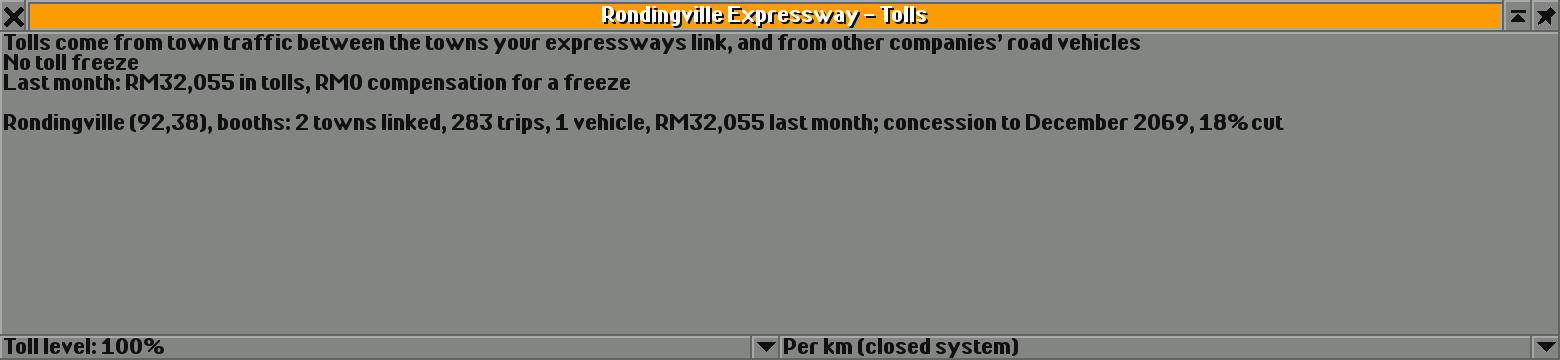
The window lists each plaza with the towns it links, last month’s trips, paying vehicles and income, and its concession. Higher tolls take more from each trip but put drivers off: at 150% a quarter fewer trips use the expressway, at 50% a quarter more. 150% is the most the regulator allows (… the regulator allows tolls of 50% to 150%). The Land Area Information of a plaza shows the same figures for that plaza.
Concessions and toll freezes
Section titled “Concessions and toll freezes”- Each plaza is a 30-year concession. When it runs out it is extended by 20 years in exchange for an 18% toll cut at that plaza, and so on, up to a 54% cut. A news message tells you.
- Each year, a company with toll plazas has a 1 in 8 chance that the government freezes its tolls for five years: at most 90% of the standard toll meanwhile, and the government pays back half the income that costs you. The Tolls window says until when.
Congestion charges
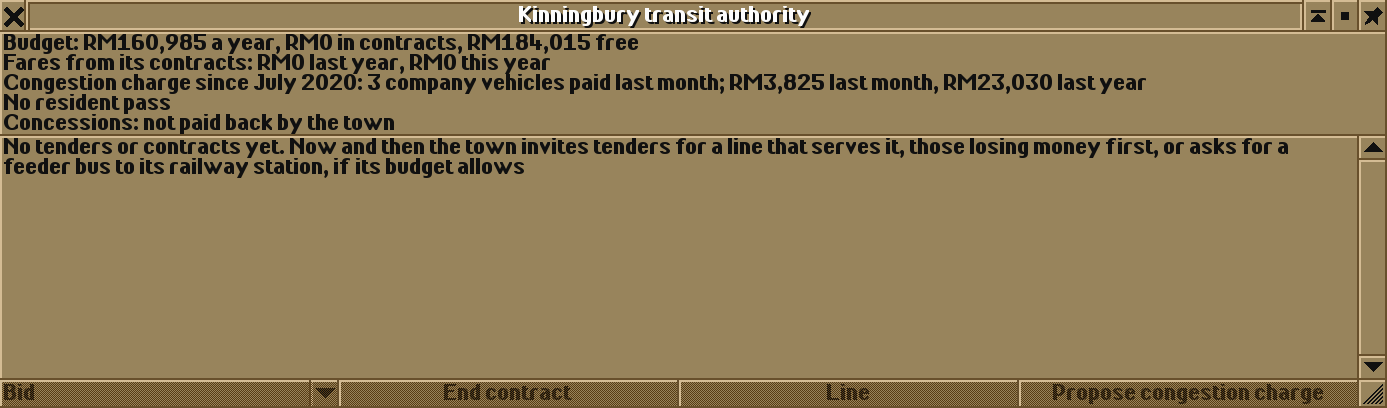
Section titled “Congestion charges”A town with a congestion charge charges every road vehicle except buses each time it drives into the town’s centre and inner suburbs. Lorries pay twice as much as vans. The town’s own drivers pay too. Town traffic in the charging zone falls by about 30% (London’s charge cut traffic by about that), and the money goes to the town’s transit budget the year after, which means more tenders and contracts for bus lines (see transit authorities).
A town brings in a charge on its own when it has 15,000 people or more and its centre is at congestion level 3 on average, and a news message says … brings in a congestion charge! From 5,000 people you can campaign for one:
- Open the town’s window (click its name in the main view, or use Towns, tooltip Open town directory or found town) and click Transit.
- The … transit authority window says No congestion charge; roads in the centre are at congestion level … on average. Click Propose congestion charge. The campaign costs money.
- The town agrees when it has 5,000 people or more, its centre is at congestion level 2 on average and it rates your company Good or better. Otherwise it says why, for example … its centre isn’t congested enough (level 2 on average).
You can also propose the charge in the town’s Budget window, with its ordinances (see budgets and ordinances).
The Land Area Information of a road in the zone says Congestion charge zone of … with what a vehicle pays to drive in (lorries twice, buses free). In a test town of 10,600 people, the centre averaged congestion level 2.4 before the charge and 1.5 to 1.8 after it.
- Link two big towns that are not too far apart: trips grow with both populations and fall with the distance. Join the expressway to each town with a road close to it.
- One plaza on an expressway is enough to collect its town traffic; more plazas only collect more from other companies’ vehicles that pass them.
- Upgrade busy plazas to free-flow: no slowdown for the traffic, and 10% more trips once every plaza on the expressway is free-flow.
- A congestion charge helps your buses twice: quieter streets in the centre, and more money for the town to spend on contracts.
Switching it off
Section titled “Switching it off”There is nothing to switch off: expressways and toll plazas exist only where you build them. Towns bring in congestion charges on their own only when they are big and jammed.
See also
Section titled “See also”- Bus lanes and bus priority: the other road types and tools for buses
- Town traffic and street life: congestion levels
- Transit authorities: where congestion charge money goes
- Budgets and ordinances: the town’s other rules
Wira Bandar PC is a fork of OpenTTD. It is OpenTTD's code with changes, not a game made from scratch. OpenTTD is made by the OpenTTD team and contributors and is free software under theGNU General Public License version 2; Wira Bandar PC keeps that licence, OpenTTD's credits and copyright notices.Source code ·OpenTTD ·About and credits
Wira Bandar PC is not made or supported by the OpenTTD team, so please don't report its bugs to OpenTTD (see FAQ and troubleshooting).