
Malaysian and Singaporean buildings
Wira Bandar PC is a fork of OpenTTD: OpenTTD's code with changes, free software under the GNU GPL v2. About and credits
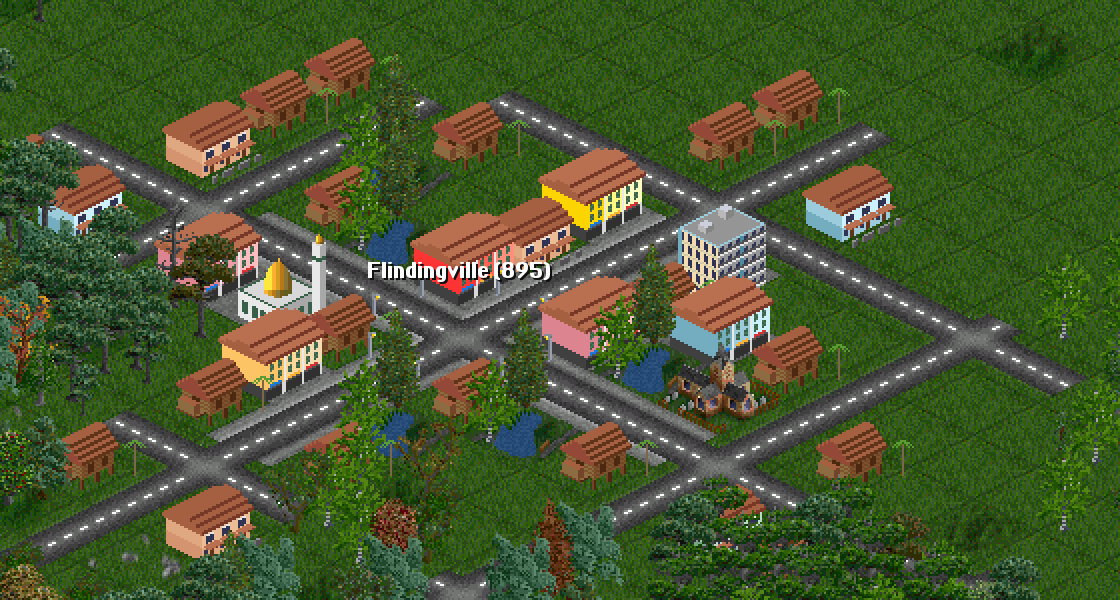
Towns in Wira Bandar PC grow the way Malaysian and Singaporean towns did: kampung houses on stilts and rows of shophouses first, then terrace houses, walk-up flats and HDB blocks, and office blocks, condominiums and glass towers in the biggest centres, with mosques and Chinese temples among them. What a town builds depends on the year, where the plot is in town, how big the town is and what the land is worth.
Choose what towns build
Section titled “Choose what towns build”The buildings come with the Town buildings setting, Malaysian and Singaporean by default.
SettingTown buildings
Main toolbar: Options and settings (the gear) → Game options → Advanced tab → Environment → Towns. Or type its name in the Filter box.
Choices: OpenTTD's, Malaysian and Singaporean, Both. Default: Malaysian and Singaporean. Choose OpenTTD's for the game as in OpenTTD.
- Malaysian and Singaporean: towns build the buildings on this page. OpenTTD’s churches, parks and stadiums still appear, and so do OpenTTD’s buildings that take food or water (towns in the desert need them), but not its statues and fountains.
- OpenTTD’s: towns build OpenTTD’s buildings only.
- Both: towns build from both sets.
The setting counts in the temperate and sub-tropical climates; towns in the sub-arctic and toyland climates keep OpenTTD’s buildings. Houses from NewGRFs are always built. Changing the setting changes only what towns build from then on: the buildings that stand stay.
The buildings
Section titled “The buildings”| Building | Built from | Where in town | Town size | People | Zoning counts it as |
|---|---|---|---|---|---|
| Kampung house: timber, on stilts, zinc roof, a coconut palm | 1900 to 1985 | Edge, outskirts, outer suburbs | Up to 20,000 people | 14 | A home |
| Terrace houses: three two-storey units with tiled roofs and porches | 1950 | Edge to inner suburbs | Any | 36 | A home |
| Shophouses: three storeys over a five-foot way, shutters, signboards | 1900 | Outer suburbs to centre | Any | 60 | A business |
| Walk-up flats: five storeys, open corridors | 1955 | Outer and inner suburbs | Any | 70 | A home |
| HDB slab block: twelve storeys on a void deck, two tiles long | 1965 | Outer suburbs to centre | From 1,000 people | 200 | A home |
| Office block: concrete, ribbon windows | 1965 | Inner suburbs, centre | From 1,500 | 140 | A business |
| HDB point block: twenty storeys | 1975 | Outer suburbs to centre | From 2,500 | 160 | A home |
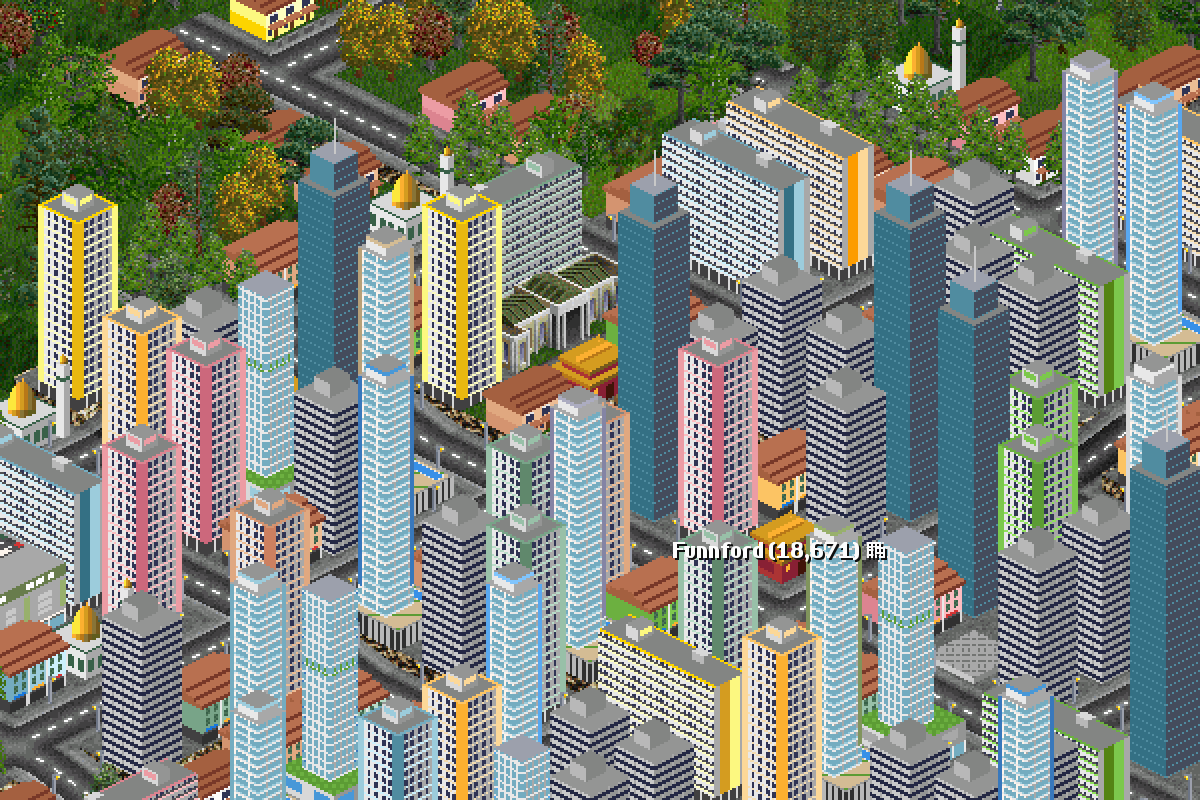
| Glass office tower: curtain wall, set-back crown, mast | 1985 | Centre | From 8,000 | 220 | A business |
| Condominium: glass balconies, pool deck on a podium | 1990 | Inner suburbs, centre | From 4,000 | 180 | A home |
| Mixed development: shops in a podium with a roof garden, a tower with a sky garden | 1995 | Inner suburbs, centre | From 12,000 | 200 | A business |
| Landmark tower: tapering steel and glass with a spire | 1998 | Centre | From 40,000; one a town | 255 | A business |
| Mosque: white walls, golden dome, minaret | 1900 | Edge to inner suburbs | One, and one more for each 6,000 people | 6 | A public building |
| Chinese temple: red walls, two-tier orange roof | 1900 | Outer suburbs to centre | One, and one more for each 6,000 people | 5 | A public building |
“People” is how many a building adds to the town’s population. Supermarkets, shopping complexes, malls and hypermarkets are on the shops page.
How a town develops
Section titled “How a town develops”- By year. Each building comes in its year (the table). No new kampung houses are built after 1985.
- By where in town. As in OpenTTD, a town has rings, from its centre through the inner and outer suburbs and the outskirts to its edge, and they widen as the town grows. Each building goes only in some of them.
- By size. The taller buildings only come once a town is big enough: HDB slab blocks from 1,000 people, office blocks from 1,500, glass towers from 8,000, a landmark tower in a city of 40,000.
- By land value. With air pollution and land value on, towns put the tall buildings where land is dear: near the centre, good stations, parks and city services. On dear land, blocks of flats and offices are up to three and a half times as likely; on cheap land, small houses are. On ordinary land towns build as in OpenTTD.
- By rebuilding. A growing town replaces its old houses from time to time, as in OpenTTD, with what it builds now. So kampung houses give way to terraces, and shophouses and terraces to blocks and towers. Bigger buildings stand for some years first: terrace houses 10, walk-up flats 15, office blocks 25, HDB blocks and condominiums 30, glass towers 40, the landmark tower, mosques and temples 60.
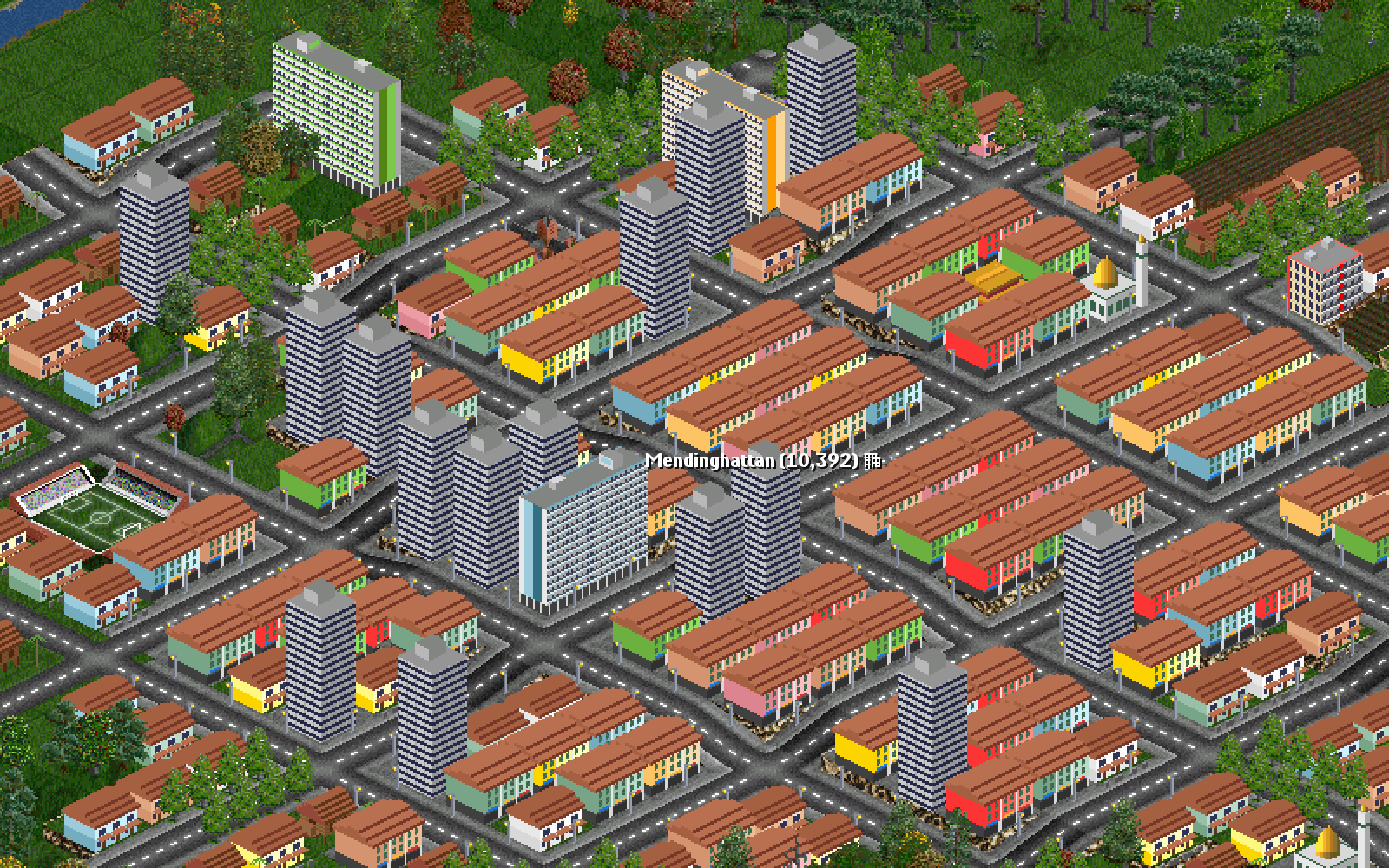
Each building gets one of eight facade colours by where it stands: light colours for terrace houses, bright ones for shophouses, walk-up flats and HDB blocks, quieter ones for condominiums and mixed developments. Kampung houses, office blocks, glass towers, mosques and temples keep their own colours. When a town council repaints its estates, its blocks of flats all change colour.
New games. A town grows from a village while the map is made, so its centre would keep the small houses it started with. Once it is made, about half the houses of its centre and inner suburbs are rebuilt the way a town of its size builds, so the tall ones stand in the middle.
Older saved games. Towns keep the buildings they have and build these from then on.
What you see
Section titled “What you see”For land information, click Help on the main toolbar (the question mark; tooltip Open land information, screenshot menu, credits, or developer tools), choose Land area information and click a building. It shows the building’s name, such as HDB point block or Kampung house, and what zoning counts it as.
- Start in the 1950s or 1960s to watch towns go from kampung houses to HDB estates; start after 2000 for towers.
- For a skyline, a town needs both people and dear land. City services, parks and a good railway station raise land value; the transit-oriented development ordinance raises it around railway stations.
- Shophouses, office blocks and towers count as businesses: they go on land zoned for shops and offices, not on land zoned for homes. See zoning.
Switching it off
Section titled “Switching it off”Choose OpenTTD’s in the Town buildings setting above. Towns keep what stands and build OpenTTD’s buildings from then on.
See also
Section titled “See also”- Shops
- Zoning
- Air pollution and land value
- Town councils: estates, repainting and rebuilt blocks
Wira Bandar PC is a fork of OpenTTD. It is OpenTTD's code with changes, not a game made from scratch. OpenTTD is made by the OpenTTD team and contributors and is free software under theGNU General Public License version 2; Wira Bandar PC keeps that licence, OpenTTD's credits and copyright notices.Source code ·OpenTTD ·About and credits
Wira Bandar PC is not made or supported by the OpenTTD team, so please don't report its bugs to OpenTTD (see FAQ and troubleshooting).