
Win a Transit First state
Wira Bandar PC is a fork of OpenTTD: OpenTTD's code with changes, free software under the GNU GPL v2. About and credits
Your company can’t stand in an election, campaign or pay anyone. Voters judge only the service they get in their own town, and that is where you come in: give a state’s biggest towns transit that their commuters use and like, and they vote Transit First. A Transit First government then tops up its towns’ transit budgets, which means more contracts for lines like yours.
This tutorial follows a real game. In May 2010 the poll for Negeri Gredinghall, a state of four towns, read Roads and Growth 8, Transit First 0. A year of bus service later, Transit First won all 9 seats.
Before you start
Section titled “Before you start”- States and elections must be on (it is by default), with Town councils and Town budgets and ordinances. See states and elections.
- Know when the vote is: general elections are in May (every state on the main land, and parliament); a region’s states vote in September. The States window lists each state’s election year.
- Plan for a year or so of game time and a good-sized bus network: transit needs a few months to win riders before the vote.
1. Choose a state
Section titled “1. Choose a state”- On the main toolbar, click Towns (the houses icon; tooltip Open town directory or found town) and choose States.
- Click each state in the list and read its details: Voters: (what bothers its voters) and If elected today: (the seats each platform would win now).
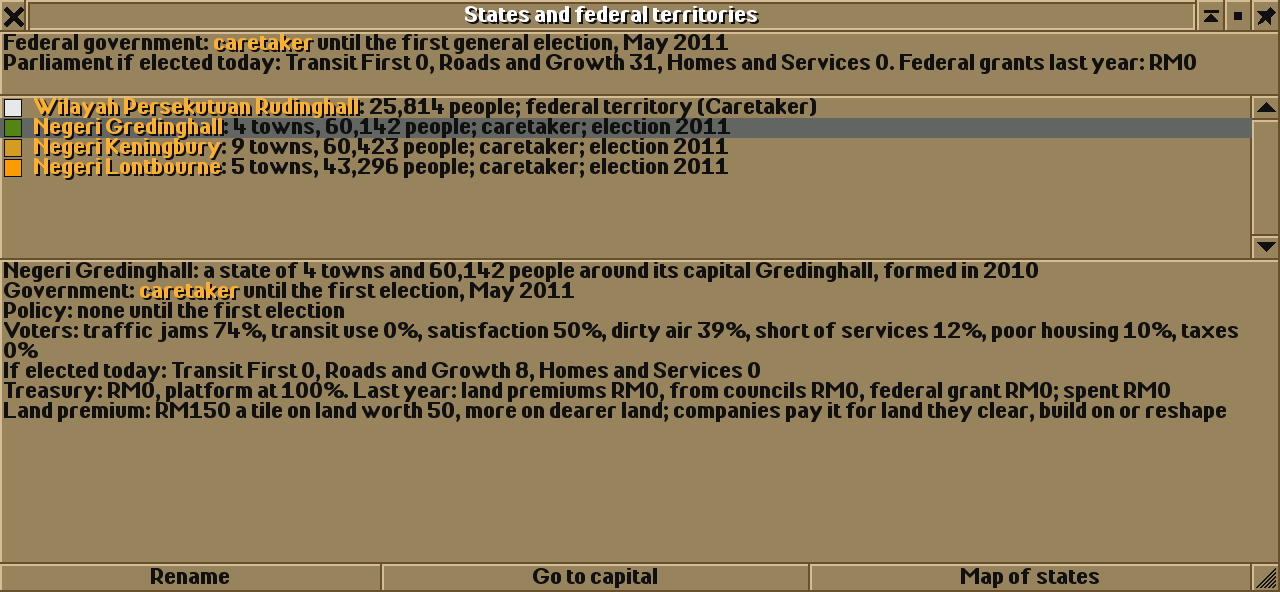
A good state to win has:
- Few towns with many people. Every town has a seat, and one more for each 10,000 people. Negeri Gredinghall has Gredinghall (23,003 people, 3 seats), Hontford (18,696, 2 seats), Fenninghead Cross (13,718, 2 seats) and Funington (4,725, 1 seat). Win Gredinghall and Hontford and you have 5 of 8.
- Traffic jams and dirty air, which Transit First promises to fix.
- Low taxes and good city services, so the other platforms have little to offer.
2. Learn what voters weigh
Section titled “2. Learn what voters weigh”Each town’s voters look at their own town, and the Voters: line shows the state’s average:
| Concern | How the game measures it |
|---|---|
| Traffic jams | four times the share of the town’s roads that are congested (a quarter of them is 100%) |
| Transit use | twice the share of commuters who go by transit (half of them is 100%) |
| Satisfaction | how satisfied riders are at the town’s stations (50% when it has none) |
| Dirty air | the town’s air pollution index (API) against 150 |
| Short of services | 100% less the average reach of police, fire, clinics, schools and parks |
| Poor housing | 100% less the condition of its estates, when a tenth of the town lives in flats (else 20%) |
| Taxes | 0% at 70% of normal taxes, up to 100% at 150% (about 37% at normal) |
| Wish to grow (not shown) | 100% less one point for every 100 people: none from 10,000 people |
Each platform appeals to some of these:
| Platform | Appeal |
|---|---|
| Transit First | 35% of transit use + 20% of satisfaction + 25% of traffic jams + 20% of dirty air |
| Roads and Growth | 35% of (100% less transit use) + 30% of traffic jams + 15% of taxes + 20% of wish to grow |
| Homes and Services | 45% of short of services + 35% of poor housing + 20% of taxes |
Each of a town’s seats goes to the platform with the highest appeal, give or take up to 6 points of chance. The platform with the most seats governs; on a tie, the one already in power keeps it. If elected today leaves out the chance. A government whose voters rate their service better than at its election (transit use, satisfaction, roads free of jams, clean air and city services together) gets up to 10 points more in every seat; one that made it worse, up to 10 fewer.
Two things follow:
- Jams alone help Roads and Growth more than Transit First. What tips a seat is transit use: it counts for Transit First and against Roads and Growth at once.
- Big cities are easier than small towns. A city of 10,000 or more has no wish to grow, so in a city with low taxes Transit First wins once about a fifth of commuters ride transit, or fewer when riders are satisfied and the air is dirty. Small towns want to grow, and towns short of services lean to Homes and Services, so they need much more.
3. Look at the towns that hold the seats
Section titled “3. Look at the towns that hold the seats”- In the States window, select the state and click Go to capital.
- Click the capital’s name sign to open its town window.
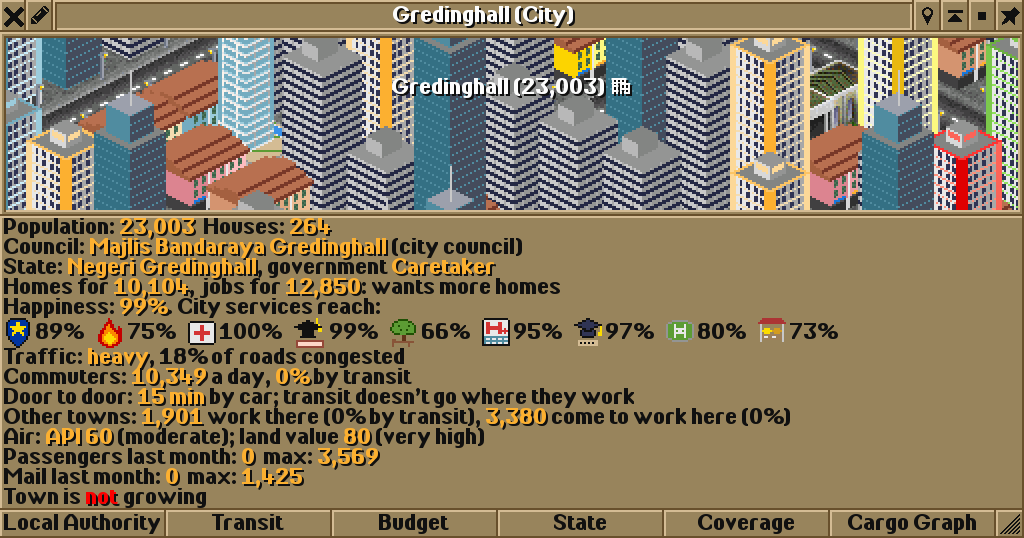
The town window shows the numbers voters use: Traffic: (the share of roads congested), Commuters: (the share by transit), Air: and, once you run stations there, the riders’ satisfaction next to Happiness:. For Gredinghall that works out as follows:
| Gredinghall | May 2010 | April 2011 |
|---|---|---|
| Roads congested → traffic jams | 18% → 72% | 0% → 0% |
| Commuters by transit → transit use | 0% → 0% | 37% → 74% |
| Riders’ satisfaction | no stations → 50% | 74% |
| Air → dirty air | API 60 → 40% | API 22 → 14% |
| Taxes | 70% of normal → 0% | 70% of normal → 0% |
| Transit First | 36 | 44 |
| Roads and Growth | 57 | 9 |
| Homes and Services | about 12 | about 12 |
4. Give commuters transit they will use
Section titled “4. Give commuters transit they will use”Commuters take transit when there is a stop within reach of their home and of their work, and when the trip isn’t much slower than by car (see commuting). A town also counts at least as many commuters on transit as the share of its passengers your stations carry suggests, so covering the whole town with well-served stops pays twice.
- Cover the biggest towns with stops: a bus stop every five or six tiles reaches nearly every building. In this game the bus company built 18 stops across Gredinghall, 16 in Hontford, 14 in Fenninghead Cross and 5 in Funington.
- Join them into lines of four or five stops, with enough buses to call often: here four buses on each line. The tutorial Your first city bus network shows how, and lines how to manage them.
- Keep riders happy: crowded, late or slow buses lower satisfaction, which counts 20% for Transit First (see passenger satisfaction).
5. Watch the poll
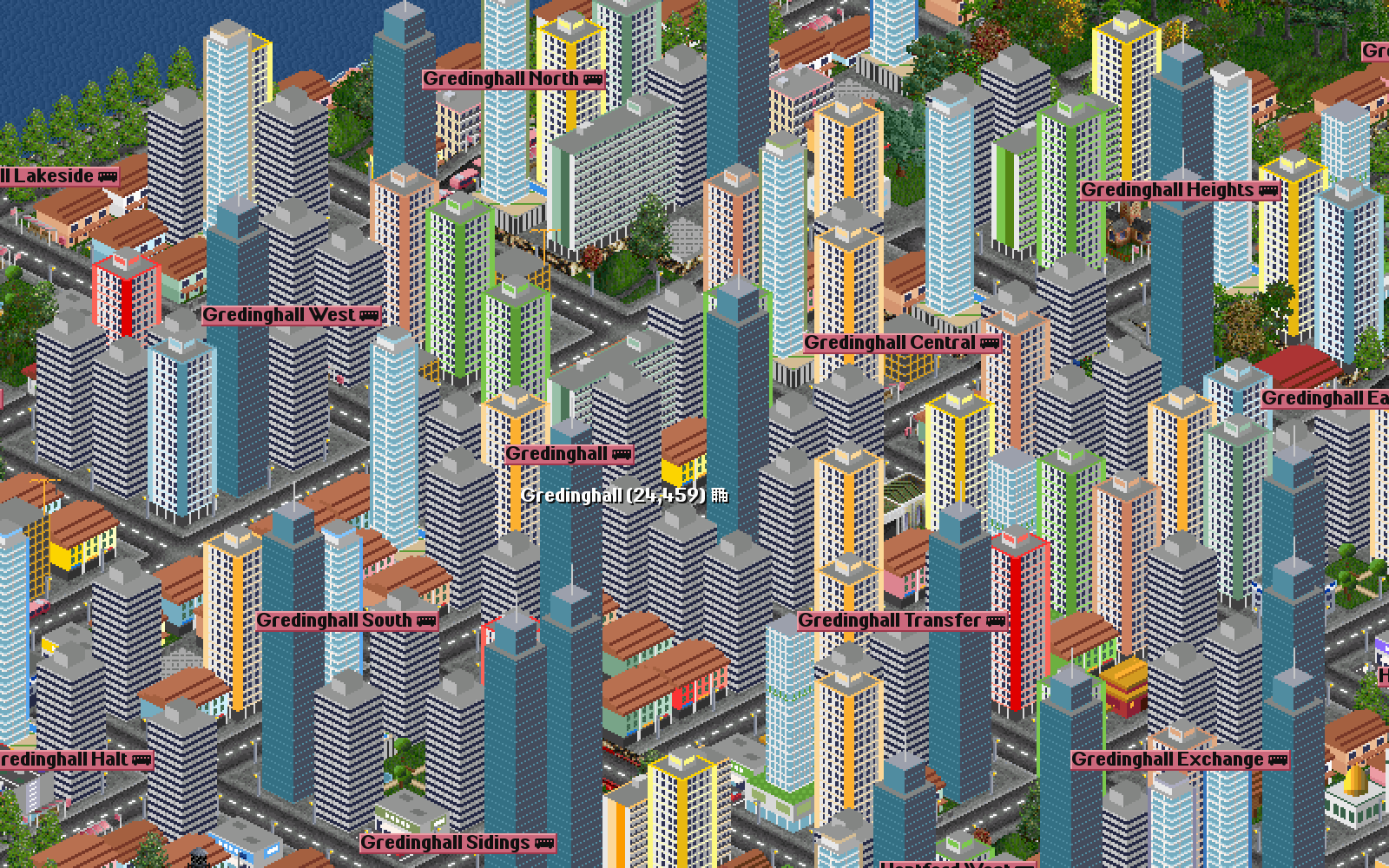
Section titled “5. Watch the poll”Give it a few months. The town counts its commuters once a month, and voters follow.
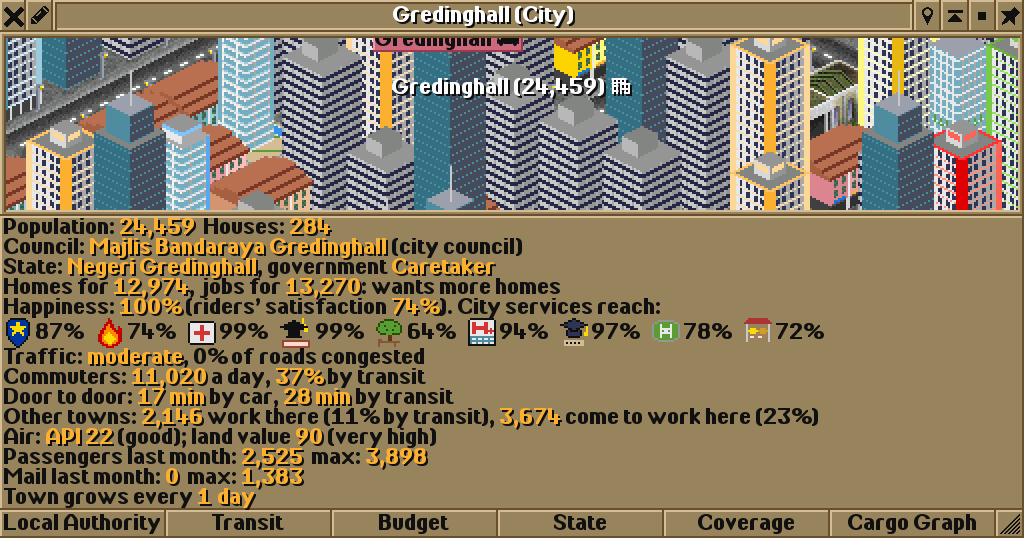
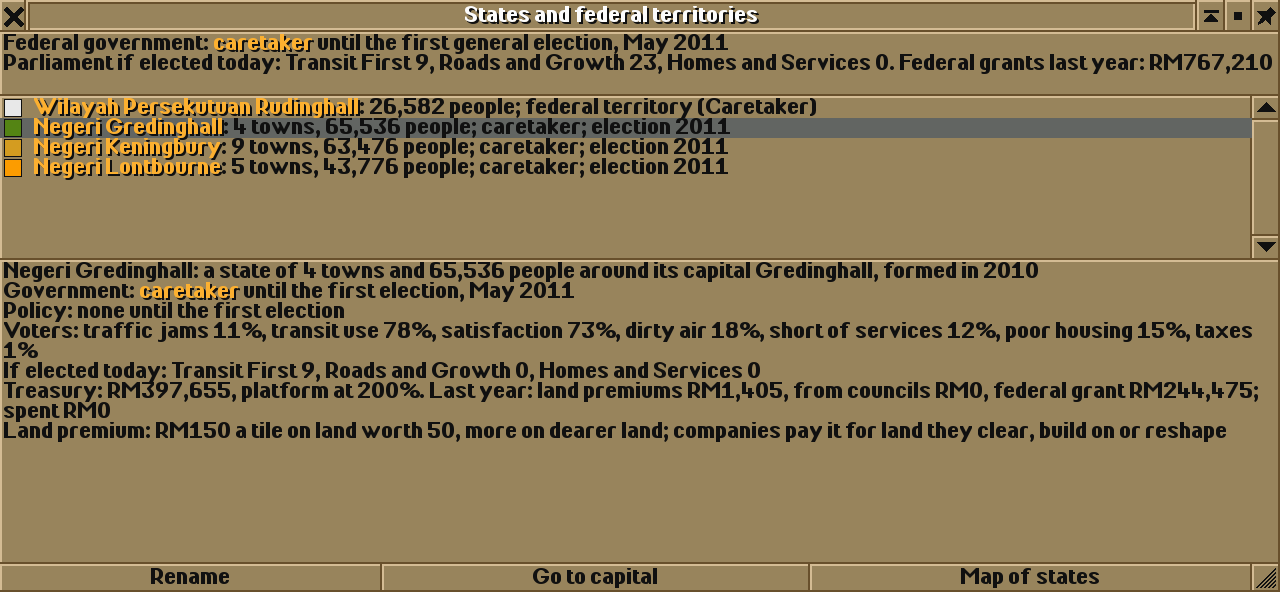
Taking cars off the road cleared the jams, and with them Transit First’s traffic points: transit use carries it now. If If elected today still favours another platform, look for the towns whose seats you lack and cover more of them, or make their service better.
6. Let the election come
Section titled “6. Let the election come”Let the game run (the fast forward button on the main toolbar, the double arrow, tooltip Fast forward the game, speeds it up). On 1 May the results come in, with news for each state and for parliament.
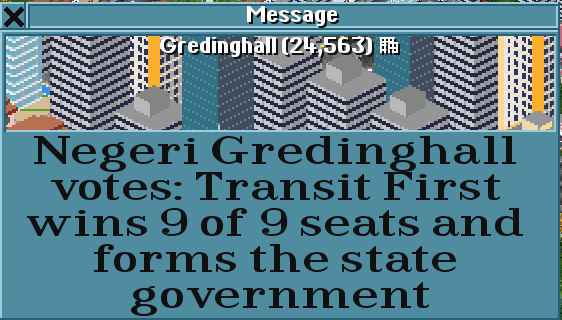
Parliament is a different matter: every town in the country votes for it, and in this game the other states had no transit, so Roads and Growth won the federal government. That government also runs the federal territories (see federal territories).
7. Use what Transit First gives
Section titled “7. Use what Transit First gives”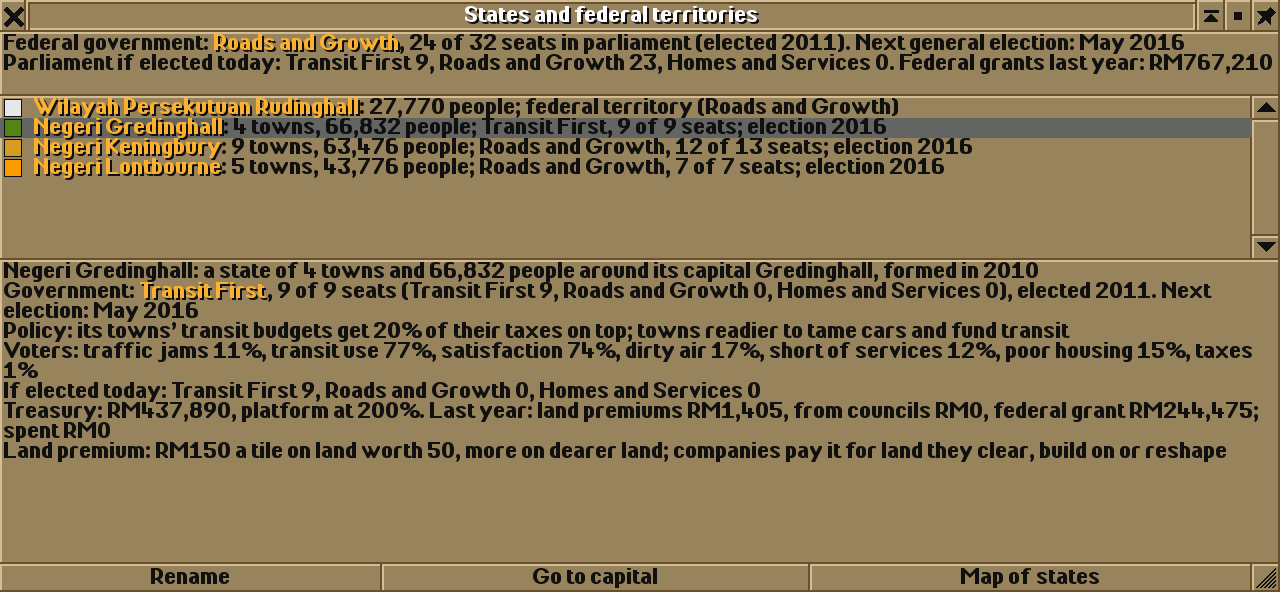
The Policy: line shows what the government does. A Transit First government gives each of its towns with a transit budget (1,500 people or more) 10% of its taxes on top, and up to 20% when its treasury has money to spare. Here the caretaker years had filled the treasury, so the platform runs at 200%.
- Open a town window and click Transit. The Budget: line shows the town’s transit budget a year, what its contracts take and what is free.
- Watch for tenders: now and then (a chance each month, at least six months apart) a town invites tenders for one of the lines that serve it, if its free budget covers the line’s cost. A line needs at least half its stops in the town and four departures a month or more. You get news when it opens.
- To bid, select the tender in the Transit window, click Bid and pick a margin from the list (0% to 40%). Rival operators bid too; the town weighs quality against price 60:40.
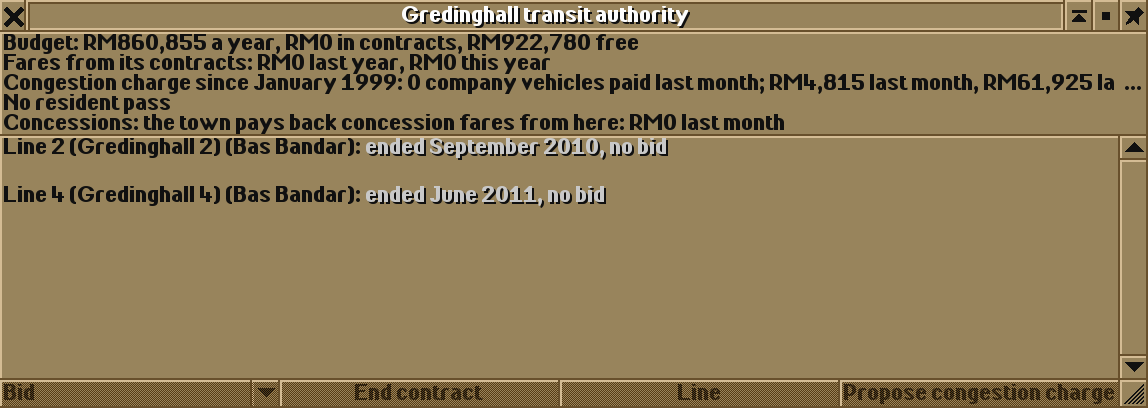
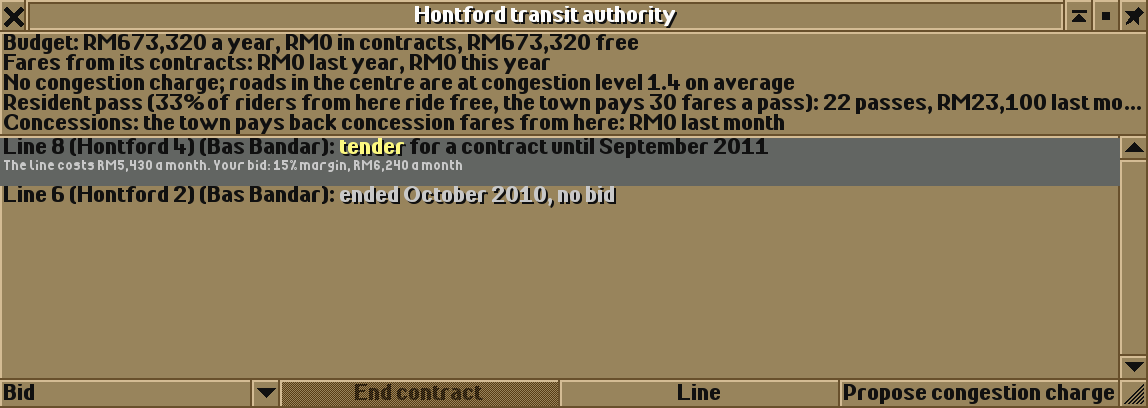
With the extra money, each town has room for more contracts, free lines, resident passes and concessions at once. The towns are also twice as ready each year to bring in a transit fund, a car-free centre, transit-oriented development, parking limits and low-emission zones (see budgets and ordinances). How contracts pay is explained in town transit authorities.
8. Keep the state
Section titled “8. Keep the state”The next election is five years away. If voters’ service is better then than at this election, Transit First gets up to 10 extra points in every seat; if it got worse, it loses them. Keep the buses running on time, keep riders satisfied, and grow the network as the towns grow.
- Start with the state’s biggest cities: a city of 20,000 has three times the seats of a village.
- Small towns are the hard part: they want to grow (Roads and Growth) and often lack services (Homes and Services). Co-funding their council’s next clinic or school (see Run a council’s services) takes away a reason to vote Homes and Services.
- A region’s states vote in September, on their own, so you can win one without the main land.
See also
Section titled “See also”Wira Bandar PC is a fork of OpenTTD. It is OpenTTD's code with changes, not a game made from scratch. OpenTTD is made by the OpenTTD team and contributors and is free software under theGNU General Public License version 2; Wira Bandar PC keeps that licence, OpenTTD's credits and copyright notices.Source code ·OpenTTD ·About and credits
Wira Bandar PC is not made or supported by the OpenTTD team, so please don't report its bugs to OpenTTD (see FAQ and troubleshooting).