Interchanges and transport hubs
Wira Bandar PC is a fork of OpenTTD: OpenTTD's code with changes, free software under the GNU GPL v2. About and credits
A station with many bus stops can become a bus interchange, with a roof over all its stops, like Singapore’s bus interchanges. Add a railway station and it can become an integrated transport hub: air-conditioned, so changing between bus and train is easy. Passengers rate both better, a hub draws people from further away, and it helps its town take cars off the road. The town pays half when its transit budget allows.
Make a station a bus interchange
Section titled “Make a station a bus interchange”- Give one station at least six bus stops: bays or drive-through stops, in any mix. Stops joined to the station from further away count too (hold Ctrl when you build a stop to choose the station to join).
- Open the station’s window: click the station or its name sign in the main view, or use the Stations list on the main toolbar.
- In the bottom row, after Departures, click Interchange.
The upgrade costs an amount for each bus stop and adds a yearly upkeep for each. If the station has fewer than six bus stops, the game says … it needs at least 6 bus stops.
- All the station’s bus stops get a roof. BRT stations keep their own platforms and roofs.
- Passengers rate the station 8% better.
- A crowd waiting there counts half: the rating looks at only half the passengers waiting, so a crowd lowers it less.
- If the station later has fewer than six bus stops, the interchange closes but keeps the upgrade (and its upkeep): the roofs and the bonus come back once it has six again.
Make it an integrated transport hub
Section titled “Make it an integrated transport hub”- Build a railway station joined to the same station (a platform of one tile will do).
- In the station window, the button now says Transport hub: click it.
The hub costs more than the interchange and adds more upkeep. The game refuses it before the interchange (… make it a bus interchange first) and without a railway station (… it needs a railway station in the same station).
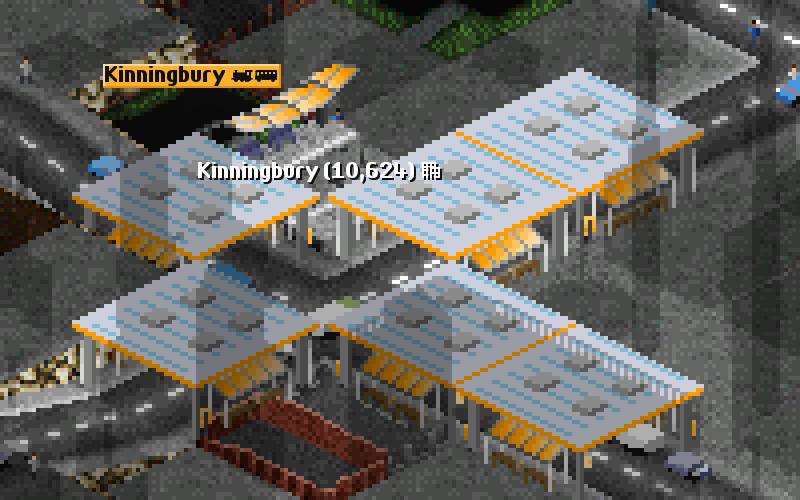
- Passengers rate it 16% better instead of 8%.
- Its catchment is 2 tiles wider: people walk further to it.
- Its town counts your transit a quarter more towards taking cars off its roads (see town traffic), because changing between bus and train is easy.
- If the railway station goes, the hub works as a plain bus interchange until you build one again.
Towns pay half
Section titled “Towns pay half”When the town’s transit budget has enough to spare this year, the town pays half of either upgrade, as Singapore’s Land Transport Authority builds the interchanges and the operators run them. The cost the game shows when you click is your part. See transit authorities for the town’s transit budget.
What you see
Section titled “What you see”In the station window, click Ratings to see the upgrade under the station’s ratings:
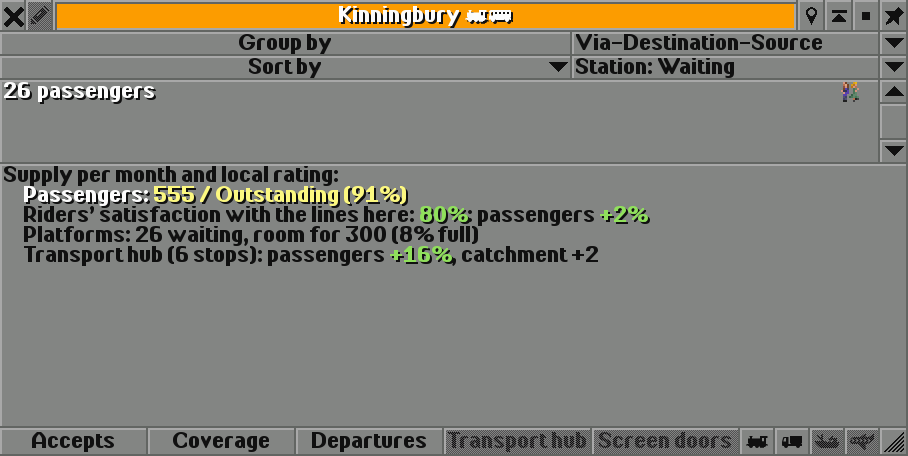
- Bus interchange (6 stops): passengers +8%, crowds count half
- Transport hub (6 stops): passengers +16%, catchment +2
- Transport hub without a railway station: a bus interchange (… stops)
- Bus interchange closed: … bus stops of 6 needed
The Land Area Information of its bus stops says Bus interchange: … bus stops under one roof or Integrated transport hub: air-conditioned, bus and train.
In a test, six stops round a town centre with a one-tile railway platform were rated 87% as an interchange, while a plain stop at the other end of the same line was rated 80%. As a hub the station was rated 91% to 96% against 74% to 80%. The town paid half of both upgrades, the catchment grew from 4 to 6 tiles, and the town centre’s congestion fell from 1.5 to 1.6 (with the interchange) to 1.2 to 1.4.
- Build the stops round one busy junction and join them into a single station, so several lines meet there.
- Upgrade early in the year: the town pays half only while its transit budget for the year has the money.
- Bus stops also make room on a hub’s railway platforms: each adds 30 places before the platforms get crowded (see metro and rail).
- A hub only makes sense where trains stop: its wider catchment and the town’s car savings come with the railway.
Switching it off
Section titled “Switching it off”There is nothing to switch off: stations become interchanges and hubs only when you upgrade them.
See also
Section titled “See also”- Busways and BRT: BRT stations and their platforms
- Metro and rail: platform crowding and screen doors at hubs
- Passenger satisfaction: the other line in the ratings view
- Transit authorities: the town’s transit budget
Wira Bandar PC is a fork of OpenTTD. It is OpenTTD's code with changes, not a game made from scratch. OpenTTD is made by the OpenTTD team and contributors and is free software under theGNU General Public License version 2; Wira Bandar PC keeps that licence, OpenTTD's credits and copyright notices.Source code ·OpenTTD ·About and credits
Wira Bandar PC is not made or supported by the OpenTTD team, so please don't report its bugs to OpenTTD (see FAQ and troubleshooting).