
Depot yards, chargers and staff
Wira Bandar PC is a fork of OpenTTD: OpenTTD's code with changes, free software under the GNU GPL v2. About and credits
In Wira Bandar PC a road depot is the home of the vehicles based there, and it has a yard: the facilities you build around it to park, charge, repair and fuel them. A bare depot is enough for a handful of buses; a big fleet needs parking places and workshops, and electric buses need chargers. You can also put a charger over a bus stop, and choose what your drivers and staff are paid.
Build a yard
Section titled “Build a yard”- Click your road depot to open its depot window.
- In the bottom row, click Yard (tooltip Show the depot’s yard: parking, chargers, workshops and the vehicles based here). The window … Road Vehicle Depot: yard opens.
- Click a facility button. Its tooltip says what it does, what it costs and its yearly upkeep.
- Click a tile next to the depot, or next to another facility of its yard.
A facility that isn’t next to your depot or its yard can’t be built (… it must be next to one of your road depots or its yard). A facility between two yards belongs to the nearer depot. Land Area Information on a facility shows its depot and upkeep (Depot yard of: …; upkeep … a year). The upkeep is paid each month with your property maintenance.
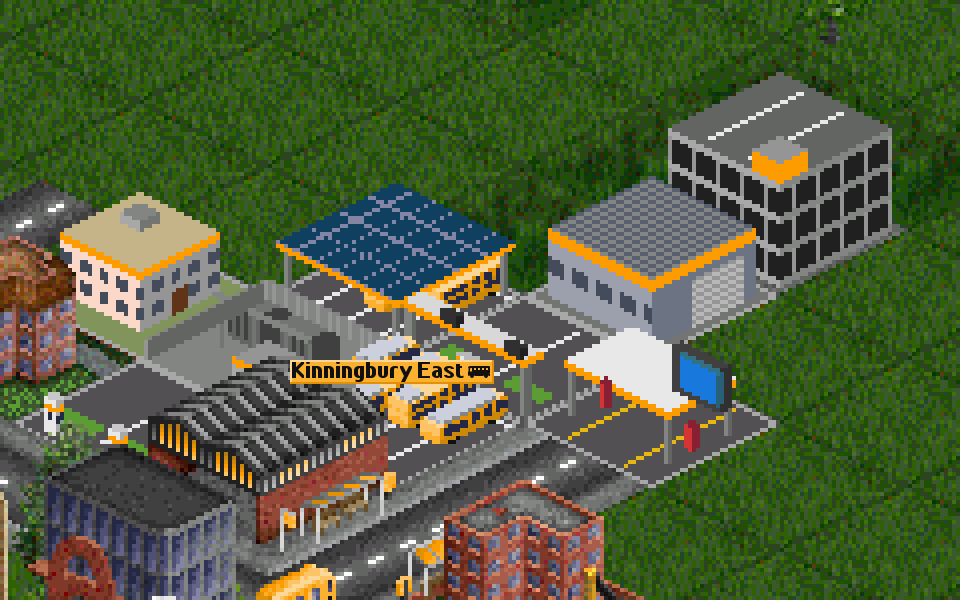
| Facility | What it does |
|---|---|
| Bus park | Room for 8 vehicles. |
| Solar bus park | Room for 8; its roof powers 6 electric buses based here, which run 15% cheaper. |
| Multi-storey park | Room for 24 vehicles on one tile. |
| Charging bay | Two chargers of 180 kWh a day, and room for 2 vehicles. |
| Fast charging bay | Two chargers of 500 kWh a day, and room for 2. It needs a substation to run at full power. |
| Substation | 3,000 kWh a day more for the depot’s chargers. |
| Repair bay | A workshop that keeps 20 more vehicles in shape. |
| Wash and fuel lane | Bulk fuel for up to 50 vehicles based here (not the electric ones): they run 8% cheaper. |
| Staff building | Canteen and lounge for the staff of 40 vehicles; it only matters with a staff budget. |
The depot itself has room for 4 vehicles, two chargers of 60 kWh a day, a grid connection of 600 kWh a day, a workshop that looks after 5 vehicles and staff rooms for 10.
Home depots
Section titled “Home depots”A road vehicle is based at the depot it was bought in, or the one it was last stopped in. (A vehicle from an older game is based at the first depot it enters; autoreplace keeps the home.) It goes home for servicing and to charge when home is at most 48 tiles away, and to charge only when its battery gets it there with room to spare. Otherwise it uses a depot on its way. The vehicle details show Home depot: ….
So a far-away home means empty runs: buy buses at a depot near their line, or stop them in the depot you want them based at.
What the yard does
Section titled “What the yard does”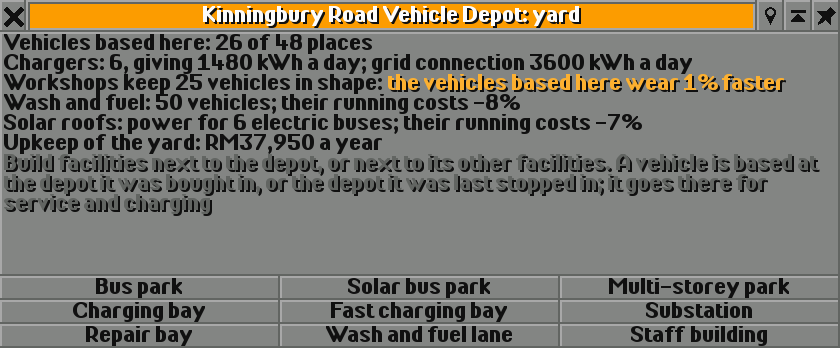
The yard window adds up what the yard offers for the vehicles based there:
- Places: when more vehicles are based here than there are places, the rest park on the street, and the vehicles cost up to 15% more to run (… park on the street: running costs +…%).
- Workshops: when more vehicles are based here than the workshops look after, they wear up to 50% faster and break down more often. With breakdowns switched off this costs nothing.
- Wash and fuel: up to 8% cheaper to run for the vehicles it fuels.
- Solar roofs: up to 15% cheaper to run for the electric buses they power.
Each effect is shared out over all the vehicles based there: 26 buses with workshops for 25 wear only 1% faster, and solar roofs for 6 electric buses make all the electric buses based there 7% cheaper on average. Any depot works this way, also one without facilities: in a test, 13 buses based at a bare depot ran at 110% of their usual running costs, from parking on the street.
Charging in the depot
Section titled “Charging in the depot”Once a day the electric buses standing in a depot get its chargers: the emptiest battery first, at the fastest charger. Together the chargers draw no more than the depot’s grid connection (600 kWh a day, plus 3,000 for each substation); when they would draw more, it is shared out. Buses without a charger wait: their status reads Waiting for a charger: 40%, the others Charging: 72%. A bus leaves at 95%. Charging buses stand at the charging bays and the other buses in the depot on the bus parks, so you see them in the yard.
The yard window shows Chargers: 6, giving 1480 kWh a day; grid connection 3600 kWh a day, and, while buses are in, how many are charging and how many wait. In a test, six electric buses with only the depot’s own chargers were found in the depot in 5 to 16% of samples; with a fast charging bay and a substation, they charged within a day and were hardly ever there.
Chargers at bus stops
Section titled “Chargers at bus stops”- On the main toolbar, click Build roads (the road icon; tooltip Build road infrastructure) and choose Road construction.
- In the Road Construction toolbar, click the lightning button (tooltip Build a fast charger over a bus stop: electric buses top up while they stand there, and one below 40% waits until it gets there. Ctrl+Click removes the charger), or press G.
- Click one of your bus stops. Ctrl+click a stop with the same tool to remove its charger.
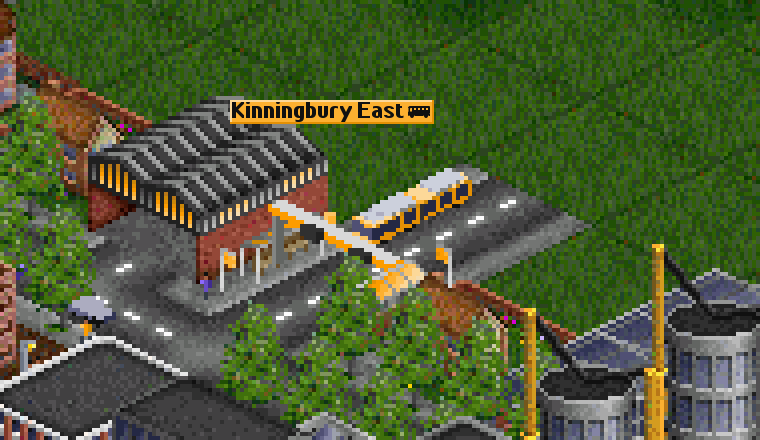
Electric buses standing at the stop get 200 kWh a day while they load, and one below 40% waits under the charger until it has 40%. The charger goes with the stop. Chargers go only over bus stops (… chargers go over bus stops); Land Area Information on the stop shows Charger for electric buses: 200 kWh a day and its upkeep. With chargers over both end stops of a line, a test line’s electric buses stayed between half and full charge and stopped going to the depot to charge.
Staff budgets
Section titled “Staff budgets”With a staff budget you choose what your road vehicles’ drivers and staff are paid:
- Lean pay: road vehicles are 6% cheaper to run, but they wear 25% faster and break down more.
- Standard pay: running costs and wear as usual.
- Generous pay: 6% dearer to run, and they wear 15% slower.
With any staff budget, depots also need staff rooms: 10 in the depot itself and 40 in each staff building of its yard. Vehicles based at a depot without room for their staff wear up to 25% faster. The yard window then has a line such as Staff rooms for 50 vehicles; Standard pay; when there are more vehicles than rooms, it adds in orange how much faster they wear.
SettingStaff budget for road vehicles
Main toolbar: Options and settings (the gear) → Game options → Advanced tab → Company. It only shows with Category: Advanced (show most settings) at the top of the tab. Or type its name in the Filter box.
Choices: Off, Lean pay, Standard pay, Generous pay. Default: Off. Choose Off for the game as in OpenTTD. Each company sets its own.
- Count the buses based at each depot, and give the yard places and workshops to match.
- Electric buses: a charging bay or two at the depot at the end of their line, or chargers over the end stops, keep them running. Add a substation before fast charging bays.
- Solar bus parks pay most for a yard of electric buses; wash and fuel lanes for diesel ones.
- Spread a big fleet over several depots near its lines instead of one huge depot far away.
Switching it off
Section titled “Switching it off”You don’t have to build any facilities: a depot then works as in OpenTTD, except that more vehicles than its 4 places and its workshop for 5 cost more to run and wear faster. Staff budget for road vehicles is Off by default; with it off, staff buildings don’t matter.
See also
Section titled “See also”- Modern and electric buses: batteries, range and charging
- Lines: the lines your depots serve
- Bus priority: the other new tools on the road toolbar
- Your first city bus network: build a first depot
Wira Bandar PC is a fork of OpenTTD. It is OpenTTD's code with changes, not a game made from scratch. OpenTTD is made by the OpenTTD team and contributors and is free software under theGNU General Public License version 2; Wira Bandar PC keeps that licence, OpenTTD's credits and copyright notices.Source code ·OpenTTD ·About and credits
Wira Bandar PC is not made or supported by the OpenTTD team, so please don't report its bugs to OpenTTD (see FAQ and troubleshooting).