
Town councils
Wira Bandar PC is a fork of OpenTTD: OpenTTD's code with changes, free software under the GNU GPL v2. About and credits
Every town is run by a council, as in Malaysia: a district council at first, then a municipal and finally a city council as it grows. The council collects business licences, builds the city services its town lacks, runs the estates of flats the way Singapore’s town councils do, and reports each January. You can co-fund its next service, and what it builds makes the town happier and bigger.
See a town’s council
Section titled “See a town’s council”- On the main toolbar, click Towns (the houses icon; tooltip Open town directory or found town) and choose Town directory, or press F5. Click a town’s name to centre the main view on it.
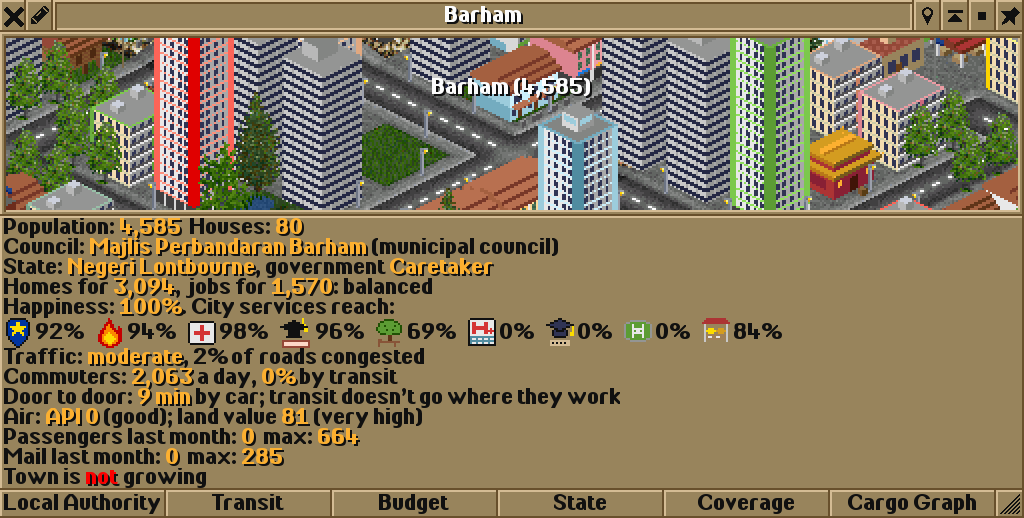
- Click the town’s name sign in the main view. The town window opens. The Council: line names its council and what kind it is.
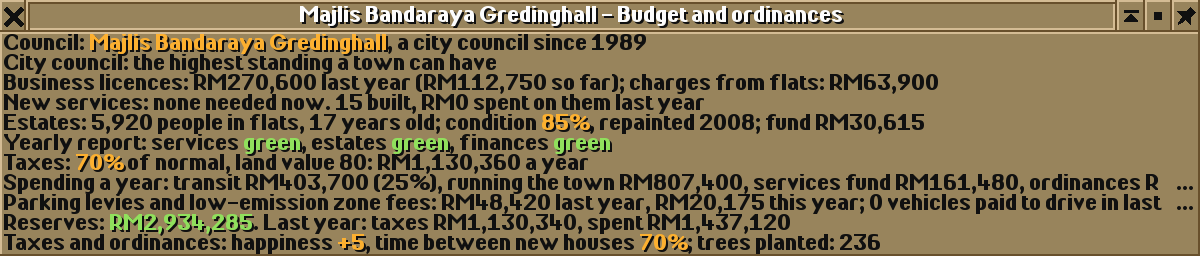
- Click Budget at the bottom of the town window. The Budget window is titled with the council’s name, and its first six lines are the council’s.
The six council lines give its standing and what it needs to move up, its licences and charges, the New services: it plans, its Estates: and its last Yearly report:, each explained below.
District, municipal and city councils
Section titled “District, municipal and city councils”| Council | In Malay | Becomes one | May also build |
|---|---|---|---|
| District council | Majlis Daerah | every town at first | police and fire stations, clinics, schools, parks, hawker centres |
| Municipal council | Majlis Perbandaran | from 4,000 people, with enough taxes and licences a year | a hospital and a stadium |
| City council | Majlis Bandaraya | from 12,000 people, with enough income, after three years as a municipality | a university |
The second council line in the Budget window shows the income needed. A town moves up each January, judged on last year’s taxes and licences, with news such as City status for Gredinghall! Majlis Bandaraya Gredinghall, and never moves down. In a new game, or an older save when you load it, every town starts with the standing it already qualifies for. A federal territory’s council is its City Hall, with a city council’s powers: see federal territories.
How a council gets its money
Section titled “How a council gets its money”The town’s taxes (see town budgets) are the council’s assessment tax. Beside them, shops and offices pay business licences: up to 30% of the town’s taxes at the normal rate, in the share of its people who work in them, so a town of offices and shops earns more. A tenth of the taxes goes into a services fund, out of what the town spends on running itself (the spending line shows it). For a new service the council can spend its fund, what companies gave it, and the town’s reserves above half a year’s taxes. When it needs nothing new, it keeps two years’ worth in the fund each January and gives the rest back to the town, which can then cut its taxes.
New city services
Section titled “New city services”Each month a council builds the service its town lacks most, as soon as it can spend enough. It aims to reach 80% of the town with clinics and schools, 70% with police and fire stations, 60% with parks and 50% with hawker centres (15 points more when the town has over two years’ taxes put by). A shortfall in clinics and schools counts most, then police and fire, then parks and hawker centres. Towns under 500 people build nothing.
The bigger buildings come with the standing, and only when the council can pay for them within three years. A municipality of 6,000 people without a hospital builds one instead of its next clinic, and a city of 12,000 without a university one instead of its next school. A municipality of 8,000 wants a hospital and a stadium of its own, and a city a university, however well its clinics and schools serve it.
It builds on free land (grass, rough land or trees; not farmland, and not zoned for homes, businesses or industry) nearer to it than to any other town, where the building reaches the most people that kind of service doesn’t reach yet: at least 100, or 600 for the two-by-two buildings. Council services are drawn in dark blue, the council’s colour, and run out of the town’s running costs: they cost companies nothing, and companies can’t remove them. Services that companies build count too, so the council builds less where you have built (see city services).
Co-fund the next service
Section titled “Co-fund the next service”In the Budget window, click Co-fund the next service. Your company pays what the council still lacks for the service named on the New services: line, and always at least a quarter of its price. The council builds it at once, the news names your company, and the town’s rating of your company goes up by about one step, up to Very Good. The button is greyed out when the council needs nothing new. If the council finds no land for it, you get … the council has found no free land for it and pay nothing. The tutorial Run a council’s services walks through it.
Estates of flats
Section titled “Estates of flats”Councils run the estates of flats (Walk-up flats, HDB block, HDB point block, and OpenTTD’s Small block of flats and Flats) as Singapore’s town councils run HDB estates. Condominiums run themselves.
- Service and conservancy charges from the flats (a fifth of a resident’s yearly taxes) go into the estates’ fund, which pays for cleaning, lifts and repairs, a little more each year once the estates are over 20 years old on average. The council tops it up from the town’s reserves when it runs dry. The condition heads for 85% while upkeep is paid in full, and down towards 40% when it isn’t.
- Repainting every six years: the condition goes to 100% and all the blocks change colour at once.
- Neighbourhood renewal every fifteen years for estates 20 years old on average, the government paying three quarters: condition 100%, and for ten years a happier town and dearer land in its suburbs.
- Rebuilding: each January a municipal or city council rebuilds one block of flats 35 years or older (on land worth 50 or more) as a new block, an HDB point block where the town builds those.
Condition counts for happiness, up to 3 points either way (70% is neutral), in the share of the town that lives in flats. While the estates are run down (below 50%), land in the suburbs is worth less. A Homes and Services state government keeps them up to 95%.
The yearly report
Section titled “The yearly report”Each January the council reports, as Singapore’s town council management reports do:
| Item | Green | Amber | Red |
|---|---|---|---|
| Services: how much of the town the services it may build reach, on average | 75% or more | 45% or more | below 45% |
| Estates: their condition | 75% or more | 55% or more | below 55% |
| Finances | in credit, taxes at most 10% over normal | in credit | in debt |
Until the first January the line reads Yearly report: the first one comes in January; a town without flats shows - for its estates.
Council names in Malay or English
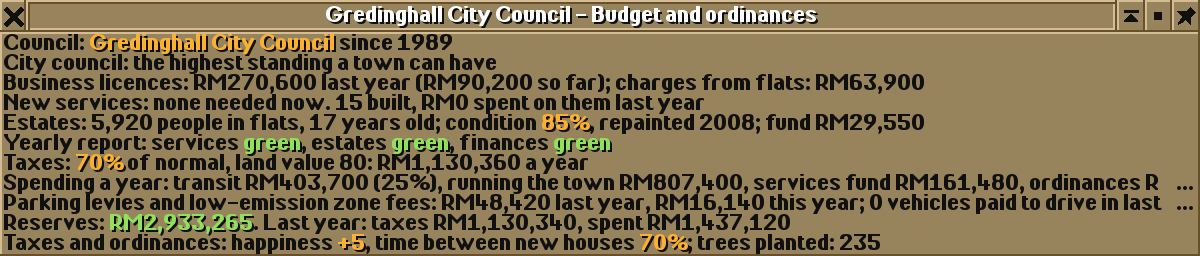
Section titled “Council names in Malay or English”Councils, states and federal territories go by their Malay names unless you choose English: then Majlis Bandaraya Gredinghall becomes Gredinghall City Council. News already in the list keeps its names.
SettingCouncil and state names
Main toolbar: Options and settings (the gear) → Game options → Advanced tab → Environment → Towns. Or type its name in the Filter box.
Choices: Malay (Majlis Perbandaran Funnford), English (Funnford Municipal Council). Default: Malay (Majlis Perbandaran Funnford). It only changes what you see, not the game, and is not stored in saves.
- A council needs free land near its town. If the New services: line names a service that never comes, the town may have no room left: free land (or land zoned as park) at its edge gives the council a place.
- Co-funding pays at least a quarter of the price even when the council lacks only a little. Co-fund where it lacks a lot; otherwise it builds the service itself within a few months.
Switching it off
Section titled “Switching it off”SettingTown councils
Main toolbar: Options and settings (the gear) → Game options → Advanced tab → Environment → Towns. Or type its name in the Filter box.
Choices: On, Off. Default: On. Choose Off for the game as in OpenTTD.
Councils need Town budgets and ordinances. With councils off there are no licences, services fund, council services, estates or reports, and no states.
See also
Section titled “See also”Wira Bandar PC is a fork of OpenTTD. It is OpenTTD's code with changes, not a game made from scratch. OpenTTD is made by the OpenTTD team and contributors and is free software under theGNU General Public License version 2; Wira Bandar PC keeps that licence, OpenTTD's credits and copyright notices.Source code ·OpenTTD ·About and credits
Wira Bandar PC is not made or supported by the OpenTTD team, so please don't report its bugs to OpenTTD (see FAQ and troubleshooting).