Settings reference
Wira Bandar PC is a fork of OpenTTD: OpenTTD's code with changes, free software under the GNU GPL v2. About and credits
All of Wira Bandar’s settings, with the help text the game shows for each, word for word. To change one: on the main toolbar click Options and settings (the gear), then Game options, then the Advanced tab, and open the pages named in the headings below (or type the setting’s name in Filter:). In the main menu, the same window changes the settings for new games.
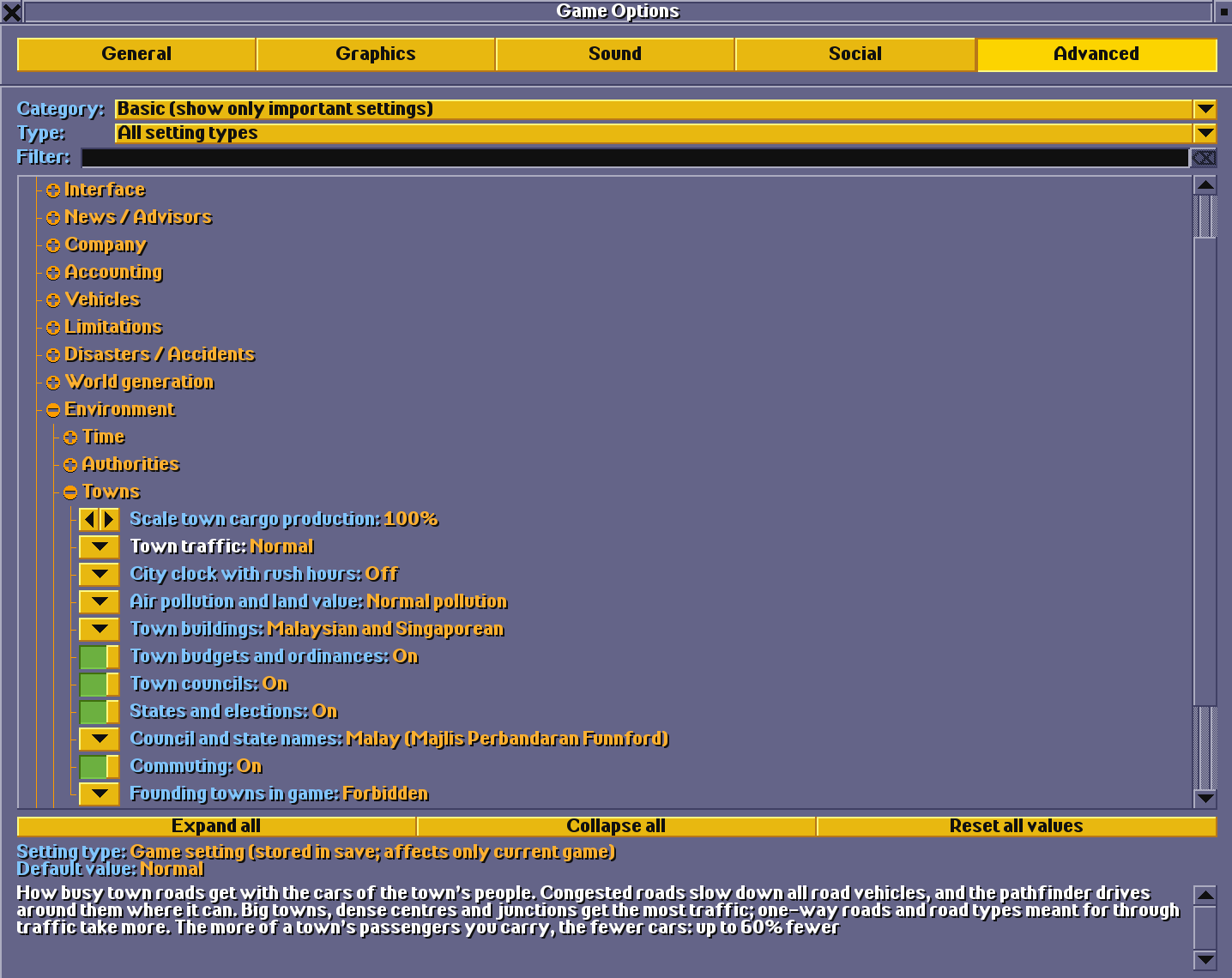
Environment → Towns
Section titled “Environment → Towns”Town traffic
Section titled “Town traffic”Default: Normal · Choices: Off, Light, Normal, Heavy · As in OpenTTD: Off · Stored in the save · openttd.cfg: [economy] town_traffic
How busy town roads get with the cars of the town’s people. Congested roads slow down all road vehicles, and the pathfinder drives around them where it can. Big towns, dense centres and junctions get the most traffic; one-way roads and road types meant for through traffic take more. The more of a town’s passengers you carry, the fewer cars: up to 60% fewer
City clock with rush hours
Section titled “City clock with rush hours”Default: Off · Choices: Off, A day per year, A day per month (fast) · As in OpenTTD: Off · Stored in the save · openttd.cfg: [economy] rush_hours
Runs a clock through the day in towns, shown next to the date. In the rush hours (06:00-09:00 and 16:00-19:00) twice as many people look for a bus and the roads are busier; at night and in the evening fewer travel and the roads are quieter. Peak bus lanes are for buses in the rush hours only. Lines can park some of their vehicles between the rush hours to save running costs, or run only in them (see the line window).
A day per year keeps pace with the vehicles: a rush hour lasts about 45 days. A day per month is faster to watch, but a rush hour then lasts only about 4 days, so only lines with short round trips can park vehicles between them.
Off: the same all day, as in OpenTTD
Air pollution and land value
Section titled “Air pollution and land value”Default: Normal pollution · Choices: Off, Light pollution, Normal pollution, Heavy pollution · As in OpenTTD: Off · Stored in the save · openttd.cfg: [economy] environment
Works out once a month how polluted the air is and what land is worth, in cells of 4 by 4 tiles. Congested roads, diesel and steam vehicles, aircraft at airports and industries pollute (processing plants and power stations the most); trees and parks clean the air; electric buses, trams and trains don’t pollute. The air is measured on Malaysia’s and Singapore’s index: good up to 50, moderate up to 100, unhealthy up to 200, very unhealthy up to 300, then hazardous.
Land is worth more near the town centre, in big towns, near city services, parks, water and good stations (railway stations the most), and less where the air is dirty or industry is near.
Polluted towns are less happy and grow slower, and think less of companies whose diesel vehicles pollute them; towns put tall blocks where land is dear and small houses where it is cheap. See the Towns menu and the map.
Off: no pollution and no land value, as in OpenTTD
Town buildings
Section titled “Town buildings”Default: Malaysian and Singaporean · Choices: OpenTTD’s, Malaysian and Singaporean, Both · As in OpenTTD: OpenTTD’s · Stored in the save · openttd.cfg: [economy] town_building_style
What towns build in the temperate and sub-tropical climates. Malaysian and Singaporean: kampung houses on stilts and rows of shophouses first; terrace houses from 1950, walk-up flats from 1955, HDB slab blocks from 1965 and point blocks from 1975 in the suburbs and around the centre; office blocks from 1965, glass towers and shopping malls from 1985, mixed developments from 1995 and condominiums from 1990 near the centre, and a landmark tower in a city of 40,000 people; mosques and Chinese temples among them. Shops for their people: supermarkets from 1965 (one for each 2,500 people), shopping complexes from 1973 (from 3,000 people), malls (from 6,000) and hypermarkets with big car parks on the edge of town from 1993 (from 5,000); towns clear old small houses for the bigger ones. Shops take goods, and food in the sub-tropics. Towns put the tall ones where land is dear (near the centre, good stations, parks and city services) and rebuild old houses into newer kinds as they grow. OpenTTD’s public buildings, and those that take food or water, stay. Changing it changes only what towns build from now on
Town budgets and ordinances
Section titled “Town budgets and ordinances”Default: On · Choices: On, Off · As in OpenTTD: Off · Stored in the save · openttd.cfg: [economy] town_budgets
Towns collect taxes, more from bigger towns and dearer land. A quarter goes to transit (the transit budget for contracts, passes and concessions), 60% to running the town; the rest pays for ordinances or builds reserves. Towns cut taxes when they have money put by and raise them when they run short; high taxes make a town less happy and slow its growth.
Towns bring in ordinances when their problems call for them and they can afford them: parking limits, a low-emission zone, a car-free centre, tree planting, transit-oriented development, a transit fund. Companies can propose them in the town’s Budget window.
Off: no budgets and no ordinances; transit budgets as before
Town councils
Section titled “Town councils”Default: On · Choices: On, Off · As in OpenTTD: Off · Stored in the save · openttd.cfg: [economy] town_councils
Towns are run by councils, as in Malaysia: a district council (majlis daerah) at first, a municipal council (majlis perbandaran) from 4,000 people with the income to match, a city council (majlis bandaraya) from 12,000 after three years as a municipality. Beside the town’s taxes, councils collect business licences from shops and offices, and they build city services from what they save: clinics, schools, police and fire stations, parks and hawker centres where the town lacks them; a hospital and a stadium once a municipality, a university once a city. Companies can co-fund the next one in the town’s Budget window. Councils also run the estates of flats as Singapore’s town councils do: service and conservancy charges pay for upkeep and for repainting every six years; old estates are renewed and the oldest blocks rebuilt. Needs town budgets
Off: towns as before
States and elections
Section titled “States and elections”Default: On · Choices: On, Off · As in OpenTTD: Off · Stored in the save · openttd.cfg: [economy] states
Towns are grouped into states, as in Malaysia: the biggest towns, spread over the map, become state capitals and every other town joins the nearest one on its land. The biggest city becomes a federal territory run by its City Hall (on big maps one more city too). A land across the sea, or behind a narrow neck of land, with two towns or more is a region run like Sabah and Sarawak: its own land laws (dearer land; forest and farmland near its towns are native customary land, which a town gives up only to companies it rates at least Mediocre) and immigration (no commuting across its border; companies can’t found towns there), and nobody may reclaim land in its waters.
States hold the land: companies pay a premium for land they clear, build on or reshape, more where land is dear. States get a federal grant and a third of what a council keeps beyond two years’ taxes. Every five years each state elects its assembly and the country its parliament (a seat a town, one more for each 10,000 people). Voters judge only what they get: traffic, transit, the air, city services, housing and taxes. The platforms (no real parties): Transit First (grants to the towns’ transit budgets), Roads and Growth (faster growth, cheaper land) and Homes and Services (grants to the councils’ services and estates). See the Towns menu, States. Needs town councils
Off: no states
Council and state names
Section titled “Council and state names”Default: Malay (Majlis Perbandaran Funnford) · Choices: Malay (Majlis Perbandaran Funnford), English (Funnford Municipal Council) · Only changes names · Your own display setting, not stored in saves · openttd.cfg: [gui] council_names
How councils, states and federal territories are called in windows and news: in Malay (Majlis Daerah, Majlis Perbandaran and Majlis Bandaraya Funnford; Negeri Funnford; Wilayah Persekutuan Funnford and Dewan Bandaraya Funnford) or in English (Funnford District Council, Municipal Council and City Council; Funnford State; Federal Territory of Funnford and Funnford City Hall). News already in the list keeps its names
Commuting
Section titled “Commuting”Default: On · Choices: On, Off · As in OpenTTD: Off · Stored in the save · openttd.cfg: [economy] commuting
Towns work out once a month where their people work and how they get there. 45% of a town’s people go to work on a day, more to places with many jobs, fewer the further away, also in up to four towns within 64 tiles they can get to by road or transit. Each can drive (the quickest way over the town’s roads, slowed by town traffic, then parking: longer in the centre, longer with parking limits, from the edge of a car-free centre) or, within reach of a stop, take transit (walking, waiting, riding, changing, the fare, walking on). The quicker transit is against the car, the more take it: half when it takes as long. At least as many take it as the share of the town’s passengers your services carry says. Drivers’ cars follow their routes, so the roads between homes and jobs get busy; homes and workplaces whose commuters find transit quick send up to twice the passengers. Needs town traffic. Off: traffic comes from the homes and jobs around each road, as before
Vehicles → Routing
Section titled “Vehicles → Routing”Road vehicles give way at junctions
Section titled “Road vehicles give way at junctions”Default: On · Choices: On, Off · As in OpenTTD: Off · Stored in the save · Shows with Category: Advanced · openttd.cfg: [vehicle] road_give_way
A road vehicle only drives onto a junction when no vehicle from the crossing road is on it, and at a busy junction vehicles take turns, longest waiting first. Busy junctions without traffic lights then slow traffic down, while traffic lights let whole queues through on green.
When disabled, vehicles drive through each other at junctions, as in regular OpenTTD
Interface → Viewports
Section titled “Interface → Viewports”Street life
Section titled “Street life”Default: Vehicles and people · Choices: Off, Vehicles, Vehicles and people · As in OpenTTD: Off · Your own display setting, not stored in saves · openttd.cfg: [gui] street_life
Show town traffic on the roads in view: cars, vans, lorries and motorbikes, as many as each road’s congestion calls for, and people on the pavements. They are only drawn: they don’t slow anything down (the congestion level does) and other players don’t see the same ones
Company
Section titled “Company”Staff budget for road vehicles
Section titled “Staff budget for road vehicles”Default: Off · Choices: Off, Lean pay, Standard pay, Generous pay · As in OpenTTD: Off · Each company sets its own · Shows with Category: Advanced · openttd.cfg: staff_budget
Off: staff are simply part of the running costs. Otherwise you choose their pay: lean pay makes road vehicles 6% cheaper to run but they wear 25% faster and break down more; generous pay costs 6% more and they wear 15% slower. With a staff budget, depots also need staff buildings: a depot has staff rooms for 10 vehicles, each staff building in its yard for 40 more, and the vehicles based at a depot without room for their staff wear up to 25% faster
Only in openttd.cfg
Section titled “Only in openttd.cfg”These change how the road pathfinder weighs Wira Bandar’s traffic. They aren’t in the settings window. For new games, edit Documents\Wira Bandar\openttd.cfg while the game is closed, in the [pf] section. In a running game, open the console (the key left of 1) and type, for example, setting pf.yapf.road_congestion_penalty 50; the save keeps it.
[pf] yapf.road_traffic_light_penalty
Section titled “[pf] yapf.road_traffic_light_penalty”Default: 50
Extra cost the road pathfinder adds for a junction with traffic lights (default: half a tile). Higher values make road vehicles avoid lights more.
[pf] yapf.road_junction_queue_penalty
Section titled “[pf] yapf.road_junction_queue_penalty”Default: 200
Extra cost for a junction where vehicles queue to give way (default: two tiles). Higher values make road vehicles avoid busy junctions more.
[pf] yapf.road_congestion_penalty
Section titled “[pf] yapf.road_congestion_penalty”Default: 100
How much the road pathfinder avoids congested roads, in percent (default: 100). 0 ignores congestion.
Wira Bandar PC is a fork of OpenTTD. It is OpenTTD's code with changes, not a game made from scratch. OpenTTD is made by the OpenTTD team and contributors and is free software under theGNU General Public License version 2; Wira Bandar PC keeps that licence, OpenTTD's credits and copyright notices.Source code ·OpenTTD ·About and credits
Wira Bandar PC is not made or supported by the OpenTTD team, so please don't report its bugs to OpenTTD (see FAQ and troubleshooting).