
Shops
Wira Bandar PC is a fork of OpenTTD: OpenTTD's code with changes, free software under the GNU GPL v2. About and credits
Towns with Malaysian and Singaporean buildings build shops for their people: supermarkets from 1965, shopping complexes from 1973, malls from 1985 and hypermarkets with big car parks on the edge of town from 1993. A town wants so many of each for its size and builds the ones it lacks readily, clearing old houses for the big ones when it has to. Shops take goods, give people jobs and, with town councils, pay business licences.
The shops
Section titled “The shops”You don’t build shops yourself: towns do, as they grow. What a town builds:
| Shop | Size | Built from | Where in town | A town wants |
|---|---|---|---|---|
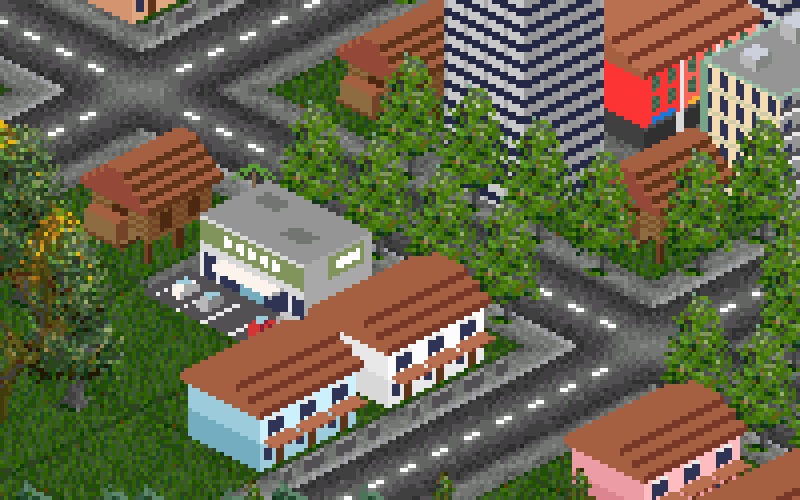
| Supermarket: a two-storey store with a glass front, a sign band and a car park | 1 tile | 1965 | Outskirts to centre | 1 from 800 people, and 1 more for each 2,500 (2 at 2,500, 3 at 5,000) |
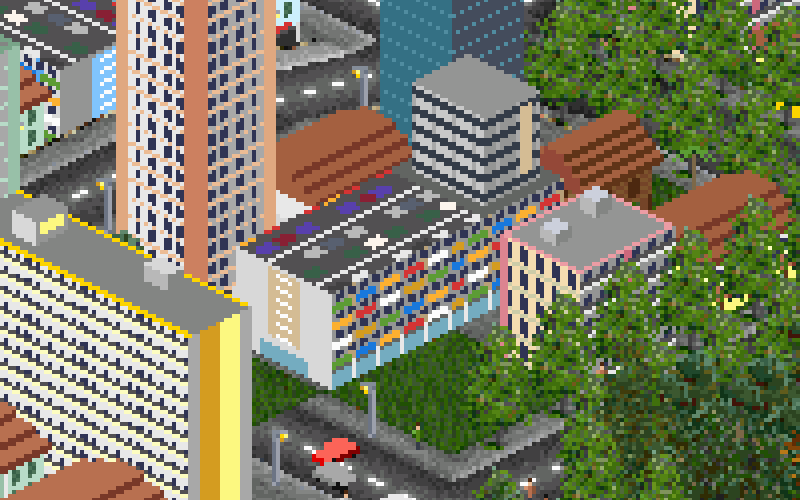
| Shopping complex: a podium of shops with rows of signboards, cars on the roof and an office tower over one end | 2 tiles | 1973 | Outer suburbs to centre | 1 from 3,000 people, and 1 more for each 10,000 (2 at 13,000) |
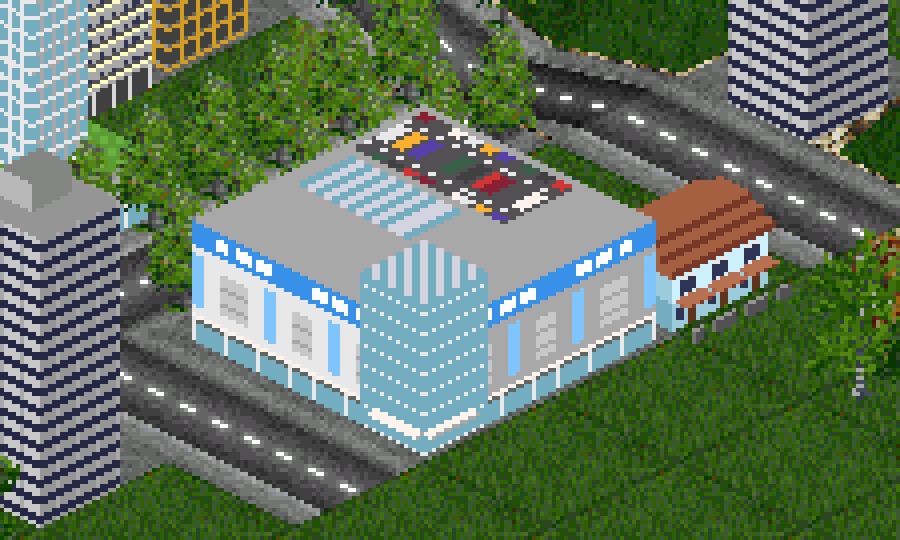
| Shopping mall: five storeys of shops with a big sign band and banners, a glass atrium at the front corner, a skylight and cars on the roof | 2 by 2 | 1985 | Inner suburbs, centre | 1 from 6,000 people, and 1 more for each 8,000 (2 at 14,000) |
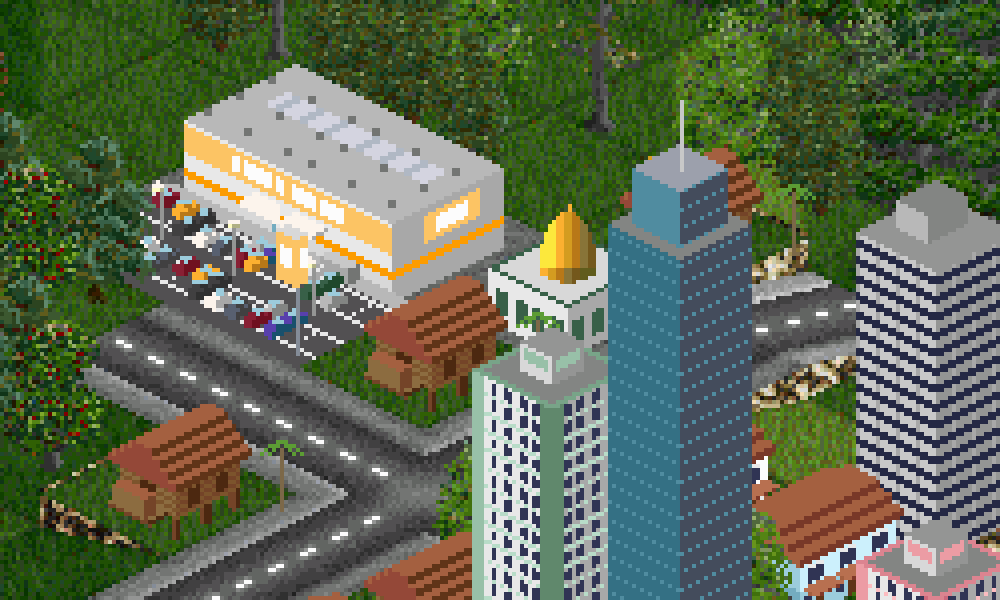
| Hypermarket: a big box with an entrance canopy, a sign band and a pylon, and a car park with rows of cars, lamp posts and a trolley shelter | 2 by 2 | 1993 | Edge, outskirts, outer suburbs | 1 from 5,000 people, and 1 more for each 15,000 (2 at 20,000) |
Supermarkets, malls and hypermarkets come in many chains’ colours (red, green, orange, blue, yellow, dark green, purple and pink), but no real brands; shopping complexes come in quieter colours.
How towns build them
Section titled “How towns build them”As the town grows. Shops come up like any other building as a town grows, but only as many of each as the town wants for its people (the table). A shop the town lacks is three times as likely to be picked as it would otherwise be.
Clearing a site. Big shops need free land of their own. Once a year, a growing town of 3,000 people or more that lacks a mall, a shopping complex or a hypermarket looks for a site: old small houses of its own on one level, possibly with some bare land among them. The houses must be one tile each with up to 70 people (kampung houses, terraces, shophouses, walk-up flats and the like) and past their minimum age; public buildings and protected houses are never cleared. If it finds one where the shop may stand, it clears the site and builds the shop, as developers buy up old houses. It tries a mall first, then a shopping complex, then a hypermarket.
Zoning. Shops count as businesses: they go on land zoned for shops and offices, or on land that isn’t zoned, never on land zoned for homes, industry or parks. A shop on several tiles needs every tile zoned for it. See zoning.
What shops take
Section titled “What shops take”Shops take goods, like OpenTTD’s shops and offices, so a station whose catchment covers one accepts goods; a supermarket takes a whole tile’s worth. In the sub-tropical climate they take food as well: a supermarket a whole tile’s worth, the bigger shops half a tile’s worth on each of their tiles. That makes them good places to deliver to.
Like any building, they also send and take passengers and mail. Their people count as jobs: commuters come to work there (see commuting).
Shops and town councils
Section titled “Shops and town councils”With the Town councils setting on (the default), each council collects business licences from shops and offices: up to 30% of the town’s taxes at the normal rate, in the share of the town’s people who work in businesses. Every building that zoning counts as a business adds to that share, shops among them. Licences go into the town’s reserves, count towards the income a council needs to become a municipal or city council, and help pay for its new city services. The council’s Budget window shows them: Business licences: … last year (… so far). See town councils.
- Deliver goods to a town’s shops: a lorry stop or station whose catchment covers a shop accepts goods.
- Hypermarkets stand on the edge of town, often away from your bus stops. Give them a stop: their staff and shoppers travel too.
- A town short of free land still gets its big shops by clearing old houses. Land zoned for homes, industry or parks is never cleared for one.
Switching it off
Section titled “Switching it off”Shops come with the Malaysian and Singaporean buildings. With OpenTTD’s in the Town buildings setting, towns don’t build them; shops that stand stay.
SettingTown buildings
Main toolbar: Options and settings (the gear) → Game options → Advanced tab → Environment → Towns. Or type its name in the Filter box.
Choices: OpenTTD's, Malaysian and Singaporean, Both. Default: Malaysian and Singaporean. Choose OpenTTD's for the game as in OpenTTD.
See also
Section titled “See also”Wira Bandar PC is a fork of OpenTTD. It is OpenTTD's code with changes, not a game made from scratch. OpenTTD is made by the OpenTTD team and contributors and is free software under theGNU General Public License version 2; Wira Bandar PC keeps that licence, OpenTTD's credits and copyright notices.Source code ·OpenTTD ·About and credits
Wira Bandar PC is not made or supported by the OpenTTD team, so please don't report its bugs to OpenTTD (see FAQ and troubleshooting).