Commuting
Wira Bandar PC is a fork of OpenTTD: OpenTTD's code with changes, free software under the GNU GPL v2. About and credits
Once a month every town works out where its people work and how they get there. Commuters drive, or, when a stop is within reach, ride your lines; the quicker transit is against the car, the more take it. Drivers’ cars load the roads between homes and jobs, so commuting decides where towns jam, and quick lines take cars off those roads and bring you more passengers.
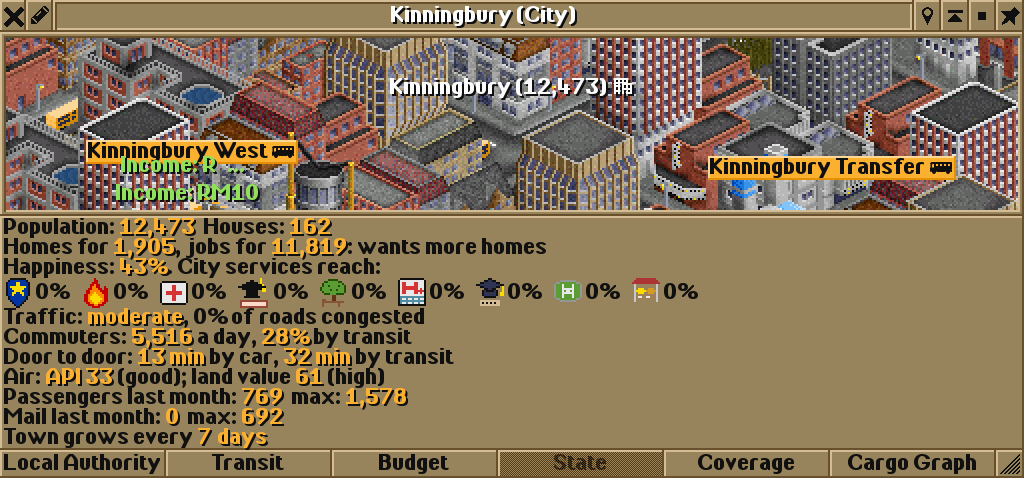
See how a town commutes
Section titled “See how a town commutes”- Click a town’s name in the main view to open its town window. It shows Commuters: how many a day and how many of them by transit, and Door to door: how many minutes the trip takes on average by car and by transit (or transit doesn’t go where they work). Until the town has counted, it says not counted yet.
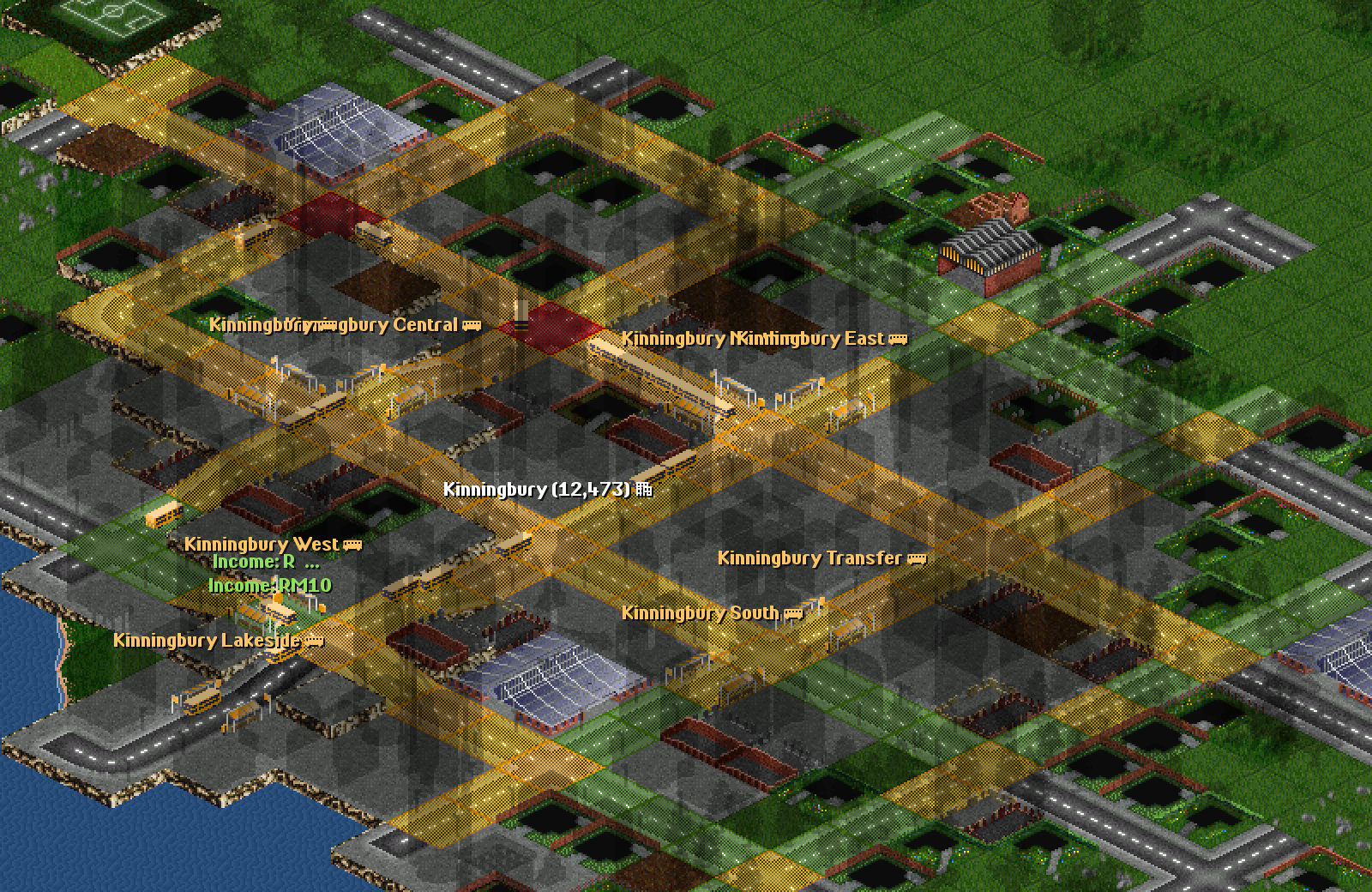
- On the main toolbar, click Towns (the houses icon; tooltip Open town directory or found town) and choose Commuter traffic map. Roads are tinted by commuters’ cars a day, both ways: green from 100, yellow from 400, orange from 1,000, red from 2,000. Choose it again to hide it.
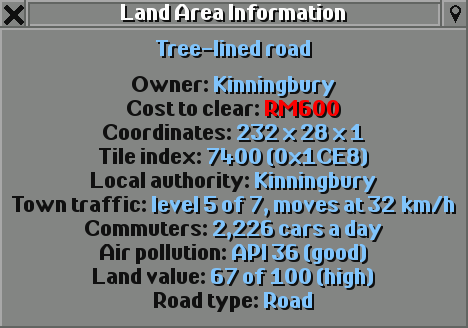
- For one road or building, use land information: click Help (the question mark; tooltip Open land information, screenshot menu, credits, or developer tools), choose Land area information and click the tile.
On a road, land information adds Commuters: with the cars a day, next to its Town traffic: level. On a home it adds Commuting from here: and on any other building Commuting to work here:, each with the share by transit.
How it works
Section titled “How it works”Who goes where
Section titled “Who goes where”Towns of 500 people or more work out their commutes once a month, each on its own day. On a day 45% of a town’s people go to work. They live in homes, and a few in flats above shops, offices and public buildings. They work in shops and offices, public buildings, city services and the town’s industries, and a few in homes. More go where there are many jobs, and fewer the further away: half as many to jobs 10 tiles away as to jobs next door. Jobs nobody can reach by road or transit draw nobody.
Drive or ride
Section titled “Drive or ride”Each commuter compares how long each way feels:
- By car: the quickest way over the roads, slower in town traffic and faster on expressways, with time lost at junctions, traffic lights, level crossings and drive-through stops. Then parking and walking to work: 5 minutes in the centre, 3 in the inner suburbs, 2 in the outer suburbs, 1 in the outskirts and half a minute at the edge. With parking limits it takes half as long again in the centre and inner suburbs; from the edge of a car-free centre it is 5 more minutes on foot. A congestion charge feels like 3 more minutes.
- By transit, only for homes and jobs within a stop’s catchment: walking to the stop and from the last one (walking feels twice as long), waiting (the line’s measured wait; waiting feels half as long again, and grows when the line’s vehicles leave more than 70% full), boarding (feels like a minute), changing (two more minutes, and the next wait), the fare (2 minutes at the standard fare, nothing on a free line, and one fare a journey) and riding (the line’s measured driving time, with a short stop at each station on the way).
Every passenger line counts, whoever runs it: buses, trams, trains and ships, but not aircraft. Of the commuters who can choose, half take transit when it feels as long as the drive, a fifth when it feels twice as long, and never more than 85%.
At least as many take transit as the share of the town’s passengers your services carry says, as before commuting: up to 60% of commuters when you carry all of them. So a line that carries passengers always takes some cars off the road.
What it does
Section titled “What it does”- Traffic follows the routes. Each driver’s route adds its cars to the roads it takes; town traffic adds half the old local traffic for errands and deliveries. The roads between homes and jobs get busy, side streets stay quieter. Routes avoid jams and are averaged month by month, so traffic spreads over parallel roads. See town traffic.
- Transit takes cars off those roads. The share of commuters taking transit is what transit takes off the road for the whole town. It also counts for ordinances: a car-free centre needs 15% of cars off the road.
- More riders. Homes and workplaces whose commuters find transit quick send more passengers: 2% more for each percent above 15% taking transit, up to twice as many at 65%. Never fewer.
Commuting between towns
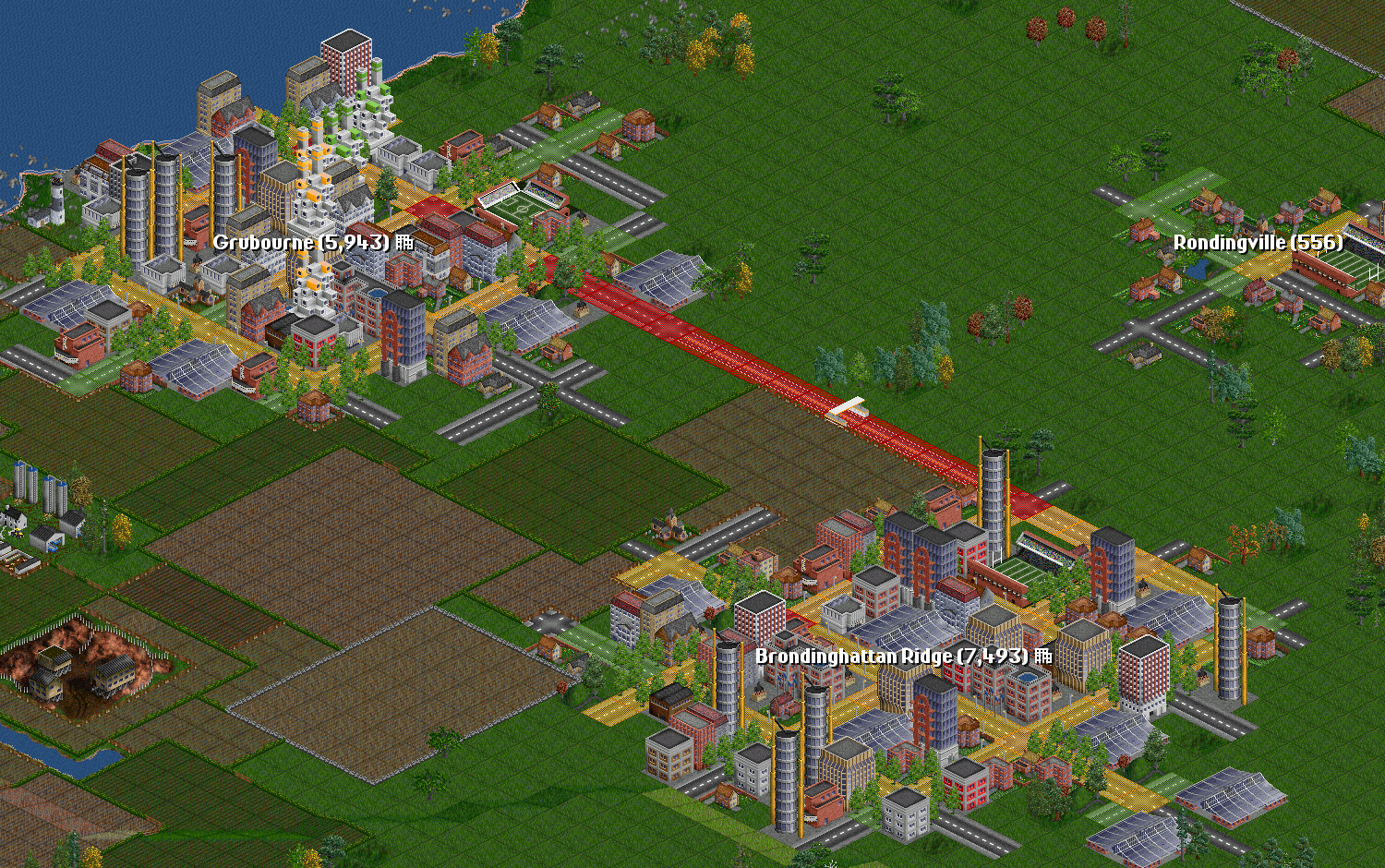
Section titled “Commuting between towns”People also work in other towns: in up to four towns within 64 tiles (between the town centres), the ones that draw them most, big and near. A suburb next to a big city sends many of its people there; two towns of the same size swap few.
- Only where they can get to. By road, which you build: OpenTTD doesn’t connect towns by road. Or by transit: a line with stops in both towns, for people living within reach of a stop, to jobs within reach of the other stop.
- On the roads between towns. Drivers’ routes run over country roads and expressways, so roads far from any town get commuter traffic and jams too. Parking, ordinances and charges are those of the town the job is in.
- Not across a region’s border. The states of a region run like Sabah and Sarawak keep their own immigration: nobody commutes between their towns and towns of any other state (see federal territories and regions).
The town window adds Other towns: how many work there and how many come to work here, each with the share by transit.
What it means for your network
Section titled “What it means for your network”- Cover homes and jobs. Only homes and workplaces within a stop’s reach can choose transit. Commuting from here: in land information shows which blocks your stops miss.
- Make lines quick. Frequent, evenly spaced vehicles cut the wait; vehicles leaving more than 70% full make it longer. Every change adds time, so run direct lines where many people travel.
- Mind the fare. A standard fare feels like 2 minutes; a cheaper one less, and a free line nothing. See fares.
- Beat the traffic. Commuters go by the line’s measured times: bus lanes and busways keep buses moving while cars sit in jams.
- Slow the cars. Parking limits, a car-free centre and a congestion charge make driving slower, so more take transit.
- Link towns. A road, an expressway or a railway between towns opens their jobs to each other. A station at the edge of town reaches few homes: put stations near the centres, or feed them with buses.
Switching it off
Section titled “Switching it off”SettingCommuting
Main toolbar: Options and settings (the gear) → Game options → Advanced tab → Environment → Towns. Or type its name in the Filter box.
Choices: On, Off. Default: On. Choose Off for the game as in OpenTTD.
Commuting needs town traffic: with Town traffic off, there is no commuting either.
SettingTown traffic
Main toolbar: Options and settings (the gear) → Game options → Advanced tab → Environment → Towns. Or type its name in the Filter box.
Choices: Off, Light, Normal, Heavy. Default: Normal. Choose Off for the game as in OpenTTD.
With commuting off, traffic comes from the homes and jobs around each road, as before, and the town window shows Your services take … of cars off the road instead of the commuting lines.
See also
Section titled “See also”- Town traffic and street life and the traffic map
- Lines, fares and bus priority
- Town budgets and ordinances
- Expressways and tolls
- Zoning: where homes and jobs go
Wira Bandar PC is a fork of OpenTTD. It is OpenTTD's code with changes, not a game made from scratch. OpenTTD is made by the OpenTTD team and contributors and is free software under theGNU General Public License version 2; Wira Bandar PC keeps that licence, OpenTTD's credits and copyright notices.Source code ·OpenTTD ·About and credits
Wira Bandar PC is not made or supported by the OpenTTD team, so please don't report its bugs to OpenTTD (see FAQ and troubleshooting).