
Passenger satisfaction
Wira Bandar PC is a fork of OpenTTD: OpenTTD's code with changes, free software under the GNU GPL v2. About and credits
Each month Wira Bandar PC asks the riders of every passenger line (buses, trams, trains, ships and aircraft) how satisfied they are, as a score from 0 to 100%. The score comes from six things riders notice: how long they wait, how crowded the vehicles are, whether they run on time, what they pay, and how good and comfortable the vehicles are. Satisfied riders rate your stations better and make their town happier, and the town thinks better of your company.
Where you see it
Section titled “Where you see it”In the line window (see lines): Passengers’ satisfaction last month and, below it, the six parts, each from 0 to 100.
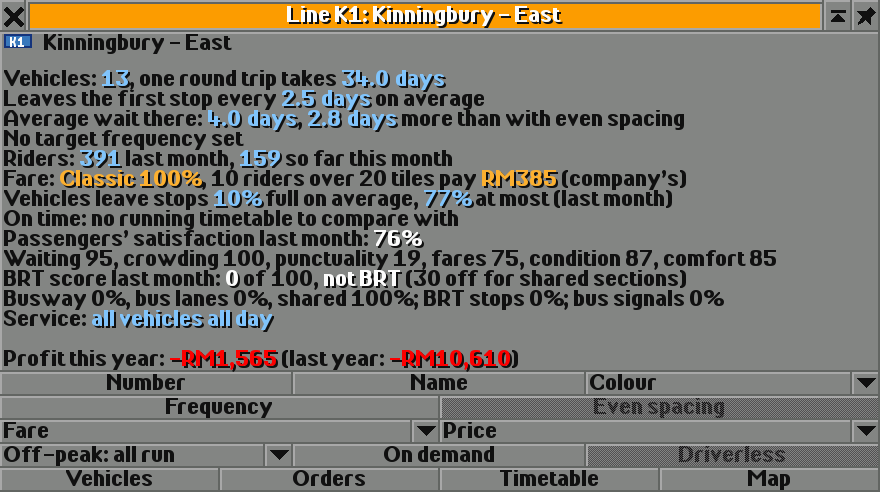
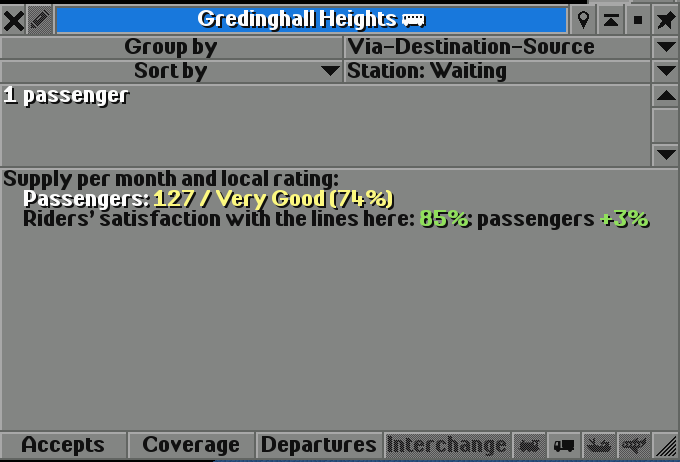
In the station window: click Ratings in its bottom row. Riders’ satisfaction with the lines here is the average of the passenger lines that stop at the station, and it says what that does to the passenger rating.
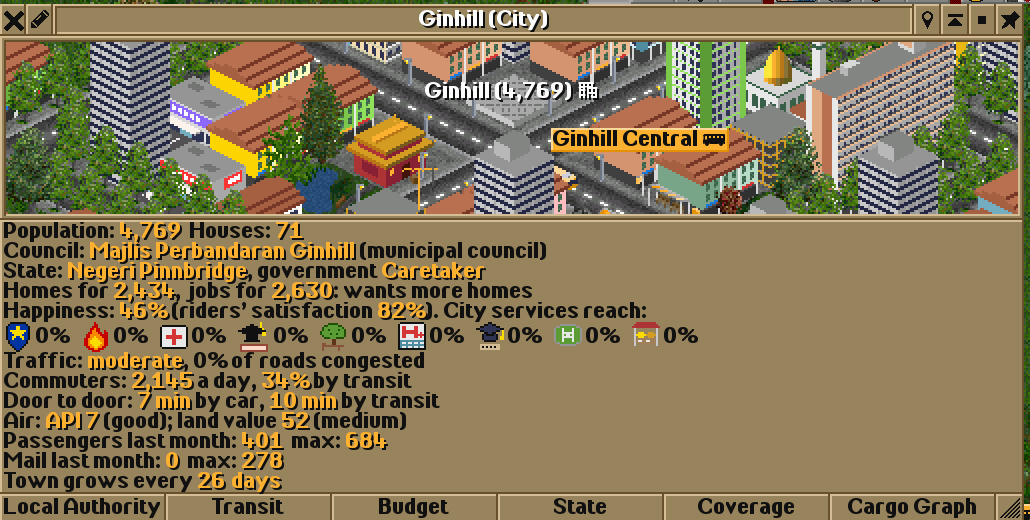
In the town window: Happiness: 46% (riders’ satisfaction 82%), the average of the town’s stations.
A line gets a score only in months when it left its first stop; until then the line window says Passengers’ satisfaction: worked out each month. Lines that carry no passengers say no passengers on this line.
The six parts
Section titled “The six parts”| Part | Weight | 100 when | Less when |
|---|---|---|---|
| Waiting | 25% | the average wait at the first stop is at most a tenth of a round trip (at least 2 days) | a quarter less for each such stretch longer |
| Crowding | 20% | vehicles leave stops at most 60% full on average | 2 points less for each percent fuller, and 10 less when one left full |
| Punctuality | 20% | departures are on time (with a timetable), or evenly spaced (without one) | without a timetable: 30 less for each extra wait as long as the wait with even spacing |
| Fares | 15% | rides are free, or cost at most half the standard fare | 75 at the standard fare, a point less for each 2% dearer |
| Condition | 10% | the vehicles are reliable | it is their average reliability |
| Comfort | 10% | air-conditioned city buses (85), quieter electric ones (95) | older buses 55 (35 in the tropics), other vehicles 70; 2 less a year from five years old |
- Waiting is measured at the line’s first stop (see lines).
- Crowding for trains also counts crowded railway platforms, whichever is worse (see metro and rail).
- Punctuality with a timetable is the share of departures from the first stop between a day early and three days late.
- Fares count the price level of the line’s fare (see fares): 100% scores 75, 150% 50, 200% 25.
- Comfort counts the game’s own city buses as air-conditioned (see buses). It drops by 2 a year for vehicles over five years old, by 30 at most.
What it changes
Section titled “What it changes”- Stations: passengers rate a station up to 5% better when its lines score 100%, and up to 8% worse at 0%. At 60% nothing changes.
- Towns: a town’s happiness goes up or down by up to 10 points with the average of its stations (no change at 50%; see city services for what happiness does).
- Your standing with the town: every month, the satisfaction at your own stations in a town raises or lowers the town’s rating of your company. Satisfied riders can lift it up to Very Good.
- Satisfaction is also one of the things voters weigh in state elections.
In a test with 13 modern buses on a town line, the line scored 78%, its weakest part punctuality (the buses bunched). At twice the price the same line scored 71% (fares 25); with only 4 buses, 63% (waiting 32); and with 8 old buses, 58% (comfort 55, punctuality 8). The town’s happiness rose from 40% to 45% with its riders at 76%.
Raise it
Section titled “Raise it”- Waiting: more vehicles on the line, and a target frequency with even spacing so they don’t bunch.
- Crowding: bigger buses or more of them where vehicles leave stops more than 60% full.
- Punctuality: even spacing, or a timetable your vehicles can keep.
- Fares: keep the price at 100% or below; free fares and half the standard fare score 100.
- Condition: service the vehicles; give their depot enough workshops (see depots); replace old ones.
- Comfort: run the modern city buses, electric if you can, and renew vehicles as they age.
In the first bus network tutorial, even spacing alone took a four-bus line from 57% to 82%.
Switching it off
Section titled “Switching it off”There is nothing to switch off: every passenger line gets a score each month. Lines that don’t carry passengers are left out.
See also
Section titled “See also”- Lines: the line window and even spacing
- Fares: the fares part and the fare effect on ratings
- Modern and electric buses: comfort
- Metro and rail: crowded platforms
Wira Bandar PC is a fork of OpenTTD. It is OpenTTD's code with changes, not a game made from scratch. OpenTTD is made by the OpenTTD team and contributors and is free software under theGNU General Public License version 2; Wira Bandar PC keeps that licence, OpenTTD's credits and copyright notices.Source code ·OpenTTD ·About and credits
Wira Bandar PC is not made or supported by the OpenTTD team, so please don't report its bugs to OpenTTD (see FAQ and troubleshooting).