Town budgets and ordinances
Wira Bandar PC is a fork of OpenTTD: OpenTTD's code with changes, free software under the GNU GPL v2. About and credits
Every town keeps a budget: it collects taxes, spends a share on transit and on running the town, and puts the rest by. When a town has a problem it can afford to tackle, it brings in an ordinance: parking limits, a low-emission zone, a car-free centre, tree planting, transit-oriented development or a transit fund. Towns decide; your company can propose an ordinance, and the town agrees when it has the problem, can afford it and thinks well enough of your company.
Open a town’s budget
Section titled “Open a town’s budget”- Click a town’s name in the main view to open its town window.
- Click Budget (between Transit and State; tooltip Show the town’s budget and ordinances: its taxes, spending and reserves, the rules it has brought in, and the ones you can propose).
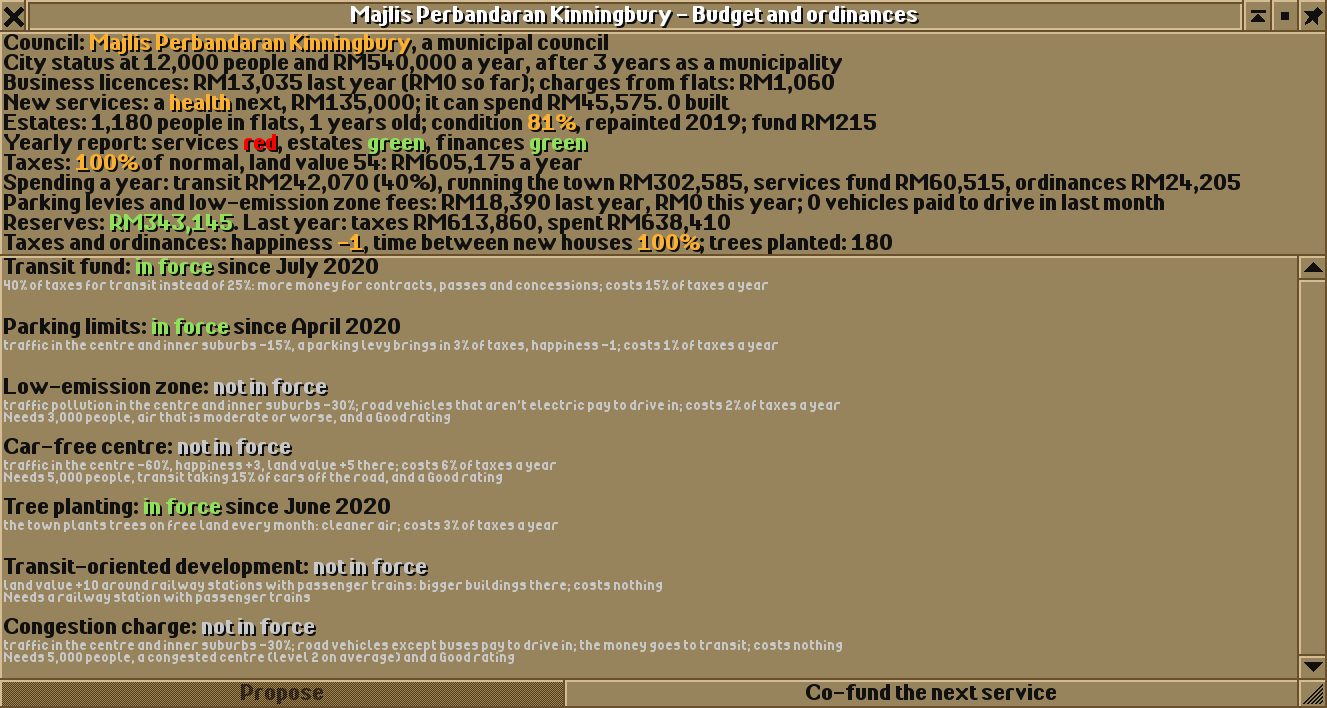
The window is called [town] - Budget and ordinances, or after the town’s council, such as Majlis Perbandaran Kinningbury - Budget and ordinances. With town councils on, six lines about the council come first (see town councils); then the budget, then the list of ordinances.
How the budget works
Section titled “How the budget works”Taxes. A town collects more from more people and from dearer land: land worth 80 brings in 30% more than land worth 50, land worth 20 brings in 30% less. With air pollution and land value off, all land counts as worth 50.
Spending is reckoned from the taxes at the normal rate, whatever the town’s tax rate:
| Share of the taxes | What for |
|---|---|
| 25%, or 40% with a transit fund | Transit: the town’s transit budget for contracts, passes and concessions (see transit authorities) |
| 60% | Running the town; with a council, 50% for running the town and 10% into the council’s fund for new city services |
| 0 to 6% for each ordinance | Its ordinances (the table below) |
| What is left: 15% without ordinances | Reserves |
A town starts with half a year’s taxes put by. Each January it looks at its money:
- In debt: taxes go up 10 points. Deep in debt (more than half a year’s taxes), it also repeals its dearest ordinance that has been in force for two years.
- After a year in surplus with more than a year’s taxes put by: taxes go down 10 points.
- After a year in deficit with less than a quarter of a year’s taxes put by: taxes go up 10 points.
Taxes run from 70% to 150% of normal. Each 5% above normal costs a point of happiness and each 5% below adds one. The time between new houses follows the tax rate: at 80% the town’s houses come a fifth sooner, at 120% they take a fifth longer.
The ordinances
Section titled “The ordinances”| Ordinance | What it does | Costs a year | You can propose it with | The town may bring it in itself with |
|---|---|---|---|---|
| Transit fund | 40% of taxes for transit instead of 25% | 15% of taxes (into transit) | 1,500 people, your buses or trains in the town, a Good rating | Transit taking 20% of cars off the road and a year’s taxes put by |
| Parking limits | Traffic in the centre and inner suburbs −15%; a parking levy brings in 3% of taxes; happiness −1 | 1% | 3,000 people, a congested centre (level 1.5 on average), a Mediocre rating | 6,000 people and a centre at level 2.5 |
| Low-emission zone | Traffic pollution in the centre and inner suburbs −30%; company road vehicles that aren’t electric pay to drive in | 2% | 3,000 people, air moderate or worse, a Good rating | 3,000 people and an air pollution index of 100 or more |
| Car-free centre | Traffic in the centre −60%; happiness +3; land value +5 there | 6% | 5,000 people, transit taking 15% of cars off the road, a Good rating | 8,000 people and 25% of cars off the road |
| Tree planting | The town plants 2 to 8 young trees a month, more for bigger towns | 3% | 1,000 people, a Mediocre rating | An air pollution index of 60 or more |
| Transit-oriented development | Land value +10 around railway stations with passenger trains, so towns build bigger there | Nothing | A railway station with passenger trains, a Mediocre rating | A railway station with passenger trains |
- Parking limits also make parking take half as long again in the centre and inner suburbs, and drivers park at the edge of a car-free centre and walk; both send more commuters to transit (see commuting).
- In a low-emission zone, a company’s road vehicle pays each time it drives in, unless it is electric (electric buses, and vehicles that run on overhead wires). Lorries pay the most, buses the least. The fee goes to the town and counts in your vehicles’ running costs.
- Tree planting puts young trees on grass and rough land in and around the town that isn’t zoned for buildings or industry. Trees clean the air; the town can still build on them later.
A town brings in at most one ordinance a year on its own, at its January review, and only by chance even when it has the problem; towns of fewer than 1,000 people bring in none. It must also afford it: the cost has to fit in what is left of its taxes (15%, less the ordinances it already has), or its reserves must hold two years of the cost. A state’s government can make its towns readier or slower to bring them in. The list also shows the Congestion charge, proposed the same way (see expressways and tolls).
Propose an ordinance
Section titled “Propose an ordinance”- Open the town’s Budget window.
- Click an ordinance in the list. Under it, what it needs; You can propose it in green means the town would agree now.
- Click Propose. If the town agrees, it brings the ordinance in at once, the news says [town] brings in a new ordinance: [ordinance], as [your company] proposed!, and your company pays for the campaign: about as much as a small station. If it doesn’t, a message says why, such as … its air is good, and you pay nothing.
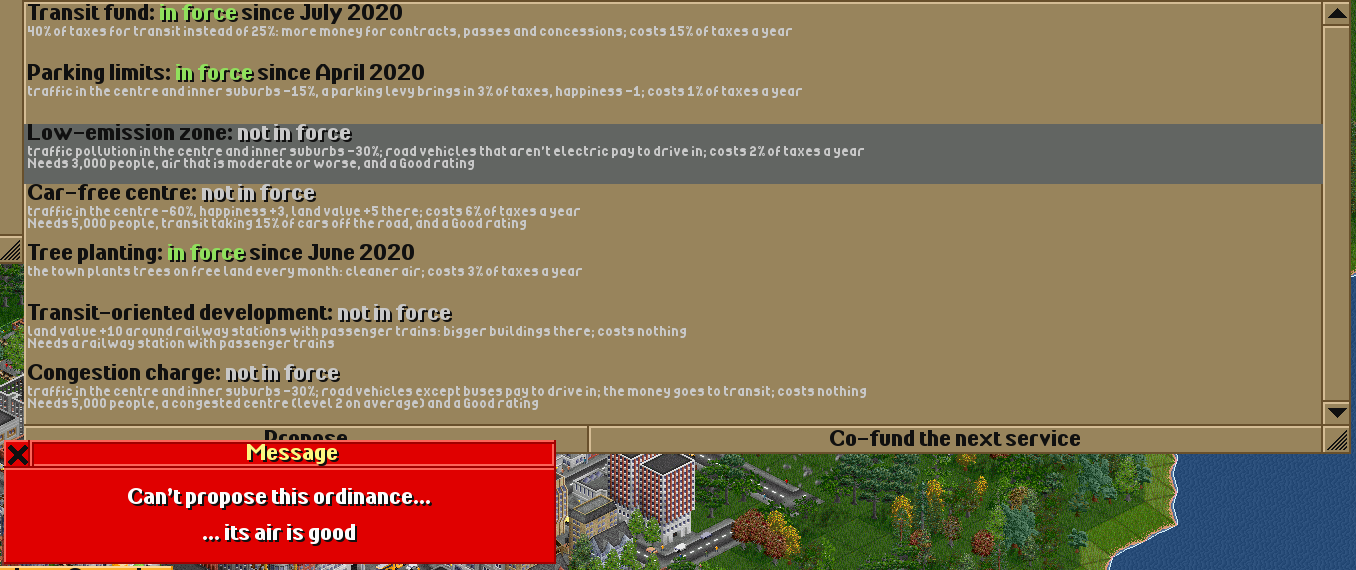
The town agrees when it has the problem, has the people and can afford it, as in the table, and when it rates your company well enough: Good for a transit fund, a low-emission zone or a car-free centre, Mediocre for the others. The rating counts only once the town has rated your company at all.
What you see
Section titled “What you see”The window’s summary has a line each for Taxes:, Spending a year:, Parking levies and low-emission zone fees:, Reserves: (in red, with in debt: taxes go up, when the town owes money) and Taxes and ordinances:, which gives their effect on happiness and on the time between new houses, and the trees planted. In the list, each ordinance is in force since a date or not in force. The news reports each ordinance a town brings in, and [town] repeals its ordinance [ordinance] to balance its budget when it drops one.
- A transit fund is worth proposing: the town’s transit budget grows from 25% to 40% of its taxes, more money for the contracts, passes and concessions your lines can win.
- Electric buses don’t pay to drive into a low-emission zone.
- Raise your rating first: city services you run for the town raise it every month.
- A town short of money repeals its dearest ordinance once it has had it for two years. A transit fund is the dearest, so it goes first.
Switching it off
Section titled “Switching it off”SettingTown budgets and ordinances
Main toolbar: Options and settings (the gear) → Game options → Advanced tab → Environment → Towns. Or type its name in the Filter box.
Choices: On, Off. Default: On. Choose Off for the game as in OpenTTD.
With budgets off, towns keep no money and bring in no ordinances, and their transit budgets work as they did before budgets. Town councils, and so states, need town budgets: they stop too.
See also
Section titled “See also”- Transit authorities: what the transit budget pays for
- Commuting
- Expressways and tolls: congestion charges
- Town councils and states and elections
- Air pollution and land value
Wira Bandar PC is a fork of OpenTTD. It is OpenTTD's code with changes, not a game made from scratch. OpenTTD is made by the OpenTTD team and contributors and is free software under theGNU General Public License version 2; Wira Bandar PC keeps that licence, OpenTTD's credits and copyright notices.Source code ·OpenTTD ·About and credits
Wira Bandar PC is not made or supported by the OpenTTD team, so please don't report its bugs to OpenTTD (see FAQ and troubleshooting).