
Modern and electric buses
Wira Bandar PC is a fork of OpenTTD: OpenTTD's code with changes, free software under the GNU GPL v2. About and credits
Wira Bandar PC adds eleven modern city buses to the purchase list, with Malaysian-flavoured names: a 16-seat minibus, a midibus, a 12 m bus, a double-decker and 18 m articulated buses, as diesel buses and as battery-electric ones. Bigger buses carry more people for the money; electric buses cost more to buy but less to run, and they need charging.
Buy one
Section titled “Buy one”- Click one of your road depots to open the depot window, and click New Vehicles.
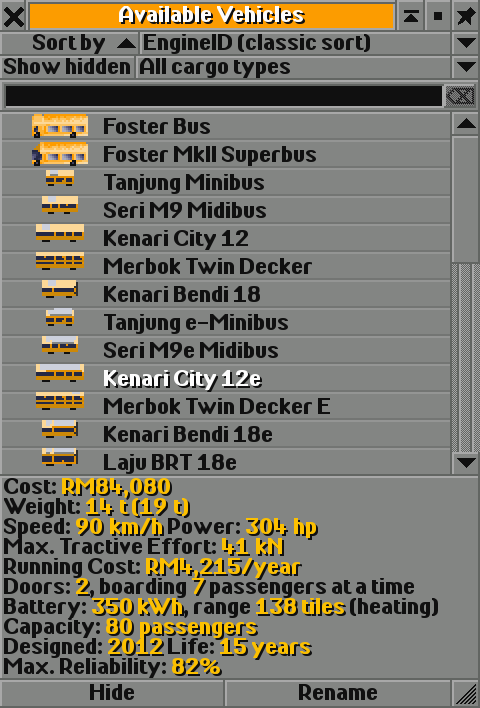
- In the New Road Vehicles list the city buses come right after OpenTTD’s own buses. Click one to see what it carries, its doors and, for an electric bus, its battery.
- Click Buy Vehicle.
To look without a depot: on the main toolbar click Road vehicles (the lorry icon; tooltip Open list of company’s road vehicles) and, in the list, Available Vehicles.
The buses
Section titled “The buses”| Bus | From | Seats | km/h | Doors (boarding at a time) | Battery | Range when new |
|---|---|---|---|---|---|---|
| Tanjung Minibus | 1985 | 16 | 100 | 1 (3) | ||
| Seri M9 Midibus | 1992 | 40 | 90 | 2 (5) | ||
| Kenari City 12 | 1995 | 80 | 90 | 2 (7) | ||
| Merbok Twin Decker | 1998 | 120 | 80 | 2 (7) | ||
| Kenari Bendi 18 (articulated) | 2000 | 150 | 80 | 3 (10) | ||
| Kenari City 12e | 2012 | 80 | 90 | 2 (7) | 350 kWh | 159 tiles |
| Tanjung e-Minibus | 2015 | 16 | 100 | 1 (3) | 110 kWh | 166 tiles |
| Laju BRT 18e (articulated) | 2015 | 140 | 100 | 4 (16) | 500 kWh | 161 tiles |
| Kenari Bendi 18e (articulated) | 2016 | 140 | 80 | 3 (10) | 500 kWh | 156 tiles |
| Seri M9e Midibus | 2016 | 40 | 90 | 2 (5) | 230 kWh | 153 tiles |
| Merbok Twin Decker E | 2018 | 115 | 80 | 2 (7) | 450 kWh | 160 tiles |
- From is the year a model is designed. In a game that starts before then, it comes out that year or up to about a year and a half later; in a game that starts later, it is on sale from the first day. The buses run in the temperate, sub-arctic and sub-tropical climates (not in toyland).
- Doors set how fast a bus loads: the purchase list says Doors: 2, boarding 7 passengers at a time.
- Range when new is without air-con or heating; the purchase list shows today’s range.
- The articulated buses, like all articulated road vehicles, need drive-through stops.
- Electric buses cost about 1.8 times as much to buy and about 0.6 times as much to run. Over 15 years a 12 m bus costs about the same either way, before the time an electric bus spends charging. Big buses cost more to run but less per seat, so they pay on busy lines and lose money on quiet ones.
- The buses are painted in your company colours (the body in the first, the roof and window pillars in the second). Diesel buses carry air-con units on the roof, electric ones battery packs.
How they compare with older buses
Section titled “How they compare with older buses”- Comfort: riders rate the air-conditioned city buses 85 for comfort and the quieter electric ones 95, against 55 for older buses (35 in the tropics), less as buses age (see passenger satisfaction).
- BRT stations: the city buses have low floors, so they load three times as fast at BRT stations, and they count for the BRT score’s level boarding (see busways and BRT).
- Contracts: towns add up to 10 quality points to your tender bids for electric lines, and give 8-year contracts instead of 5 when at least half of a line’s buses are electric (see transit authorities).
- Clean air: electric buses give off no exhaust and don’t pay to enter low-emission zones (see air pollution).
Batteries
Section titled “Batteries”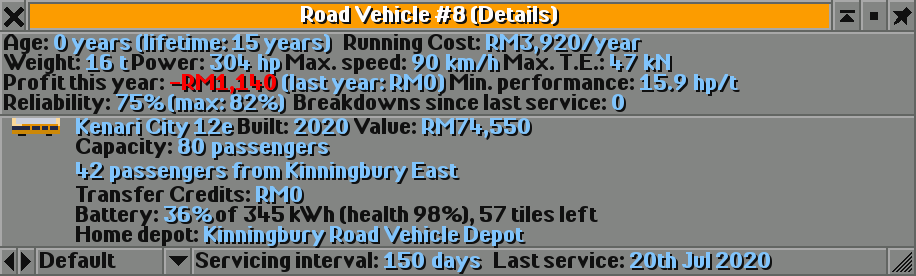
- A tile counts as about 2 km: a 12 m bus uses 2.2 kWh a tile, so a new battery lasts about 150 to 170 tiles.
- Air-con and heating use more: in the sub-tropical climate 20% more all year; in the temperate climate 10% more from June to August and 15% more from December to February; in the sub-arctic climate 25% more from November to March and 5% more the rest of the year. The details window says (air-con +20%) or (heating +15%).
- Batteries fade by 2% for each year of age, down to 60% of what they held when new: the health in the details.
- Below 25% a bus heads for a depot, unless it is loading: its home depot when that is at most 48 tiles away and the battery gets it there with room to spare, otherwise any depot not far out of its way.
- A bus that runs its battery flat crawls at 15 km/h to the nearest depot, with a message (… has run its battery flat and crawls to a depot to charge).
- In a depot a bus charges and leaves at 95%. Its status reads Charging: 72%, or Waiting for a charger: 72% when all chargers are busy. How fast it charges depends on the depot’s chargers; chargers over bus stops top buses up on the way. Both are on the depots page.
- Base electric buses at a depot near their line, with charging bays, or put chargers over the line’s end stops.
- Replace diesel buses with electric ones by autoreplace: it works for the articulated buses too, and new buses start with a full battery.
- Pick the size by the line: the line window’s Vehicles leave stops … full line (see lines) tells you whether the buses are too big or too small.
- The city buses stay on sale next to the vehicles of NewGRF vehicle sets. When you load a game from before they existed, models already designed are on sale at once.
Switching it off
Section titled “Switching it off”There is nothing to switch off: they are simply more buses to choose from. Electric buses need charging only if you buy them.
See also
Section titled “See also”- Depot yards, chargers and staff: charging, home depots and yards
- Lines: run your buses as numbered lines
- Busways and BRT: low-floor buses at BRT stations
- Your first city bus network: buy your first buses
Wira Bandar PC is a fork of OpenTTD. It is OpenTTD's code with changes, not a game made from scratch. OpenTTD is made by the OpenTTD team and contributors and is free software under theGNU General Public License version 2; Wira Bandar PC keeps that licence, OpenTTD's credits and copyright notices.Source code ·OpenTTD ·About and credits
Wira Bandar PC is not made or supported by the OpenTTD team, so please don't report its bugs to OpenTTD (see FAQ and troubleshooting).