Busways and BRT
Wira Bandar PC is a fork of OpenTTD: OpenTTD's code with changes, free software under the GNU GPL v2. About and credits
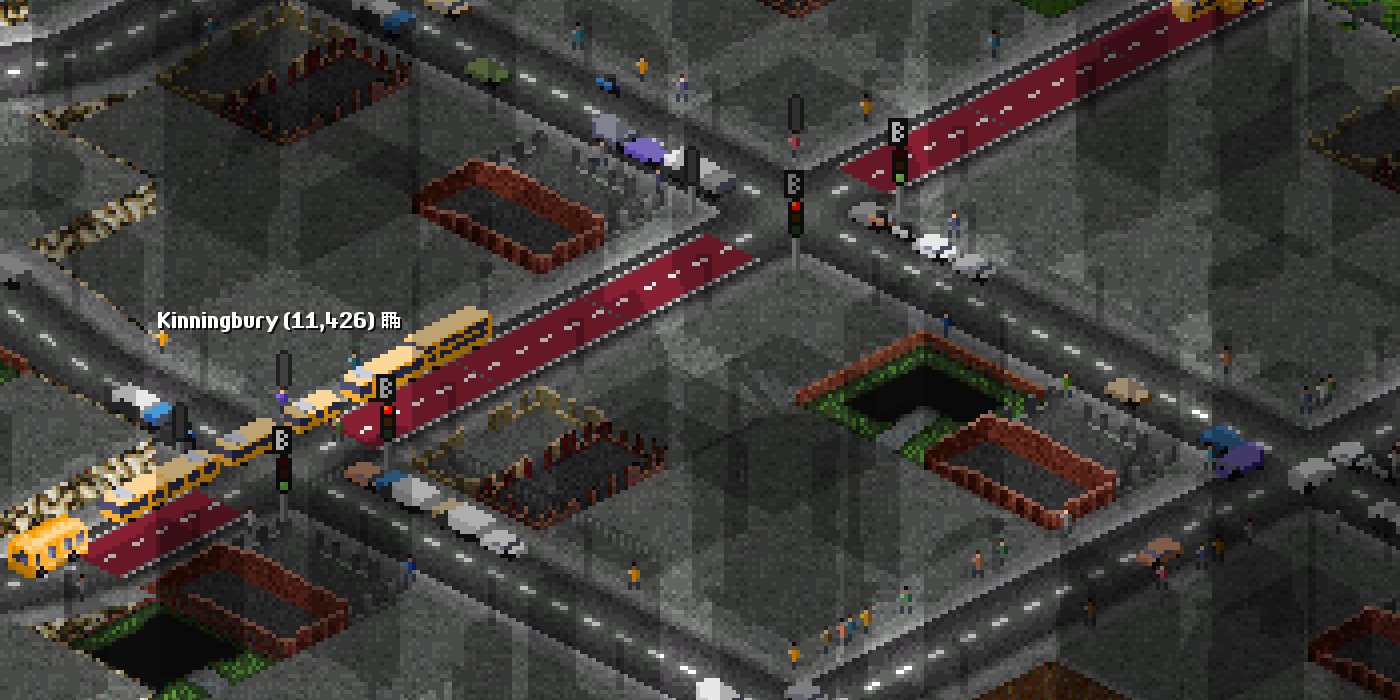
Bus lanes help buses past town traffic; busways take them out of it. A kerbed busway runs down the middle of a street, a concrete viaduct lifts a bus-only road over the town with stations on the viaduct, and BRT stations let riders pay before they board, so buses load much faster. Every bus line gets a monthly BRT score, and a line that makes the grade gets better station ratings and wins town tenders more often.
Build a kerbed busway
Section titled “Build a kerbed busway”- Open the Bus Priority toolbar: in the road toolbar click the bus priority button, or press Y (see bus priority).
- Click the busway button (a red lane between kerbs; tooltip Build a kerbed busway in the middle of the road), or press 5.
- Drag along a straight road. The busway goes on every piece of road and drive-through stop under the drag.
- To remove it, Ctrl+drag over it.
A busway can go on any road you may paint a bus lane on: your own roads, roads nobody owns and town roads too. Buses on it ignore town traffic, as on an all-day bus lane, and the other traffic, a lane short, counts the road as one congestion level busier. The kerbs keep the town’s cars off it; they still cross it at junctions. Unlike a painted lane, it counts as a busway for the BRT score. It costs two and a half times as much a tile as an all-day lane, and replaces any lane on the tiles you drag over.
Build an elevated busway with stations on the viaduct
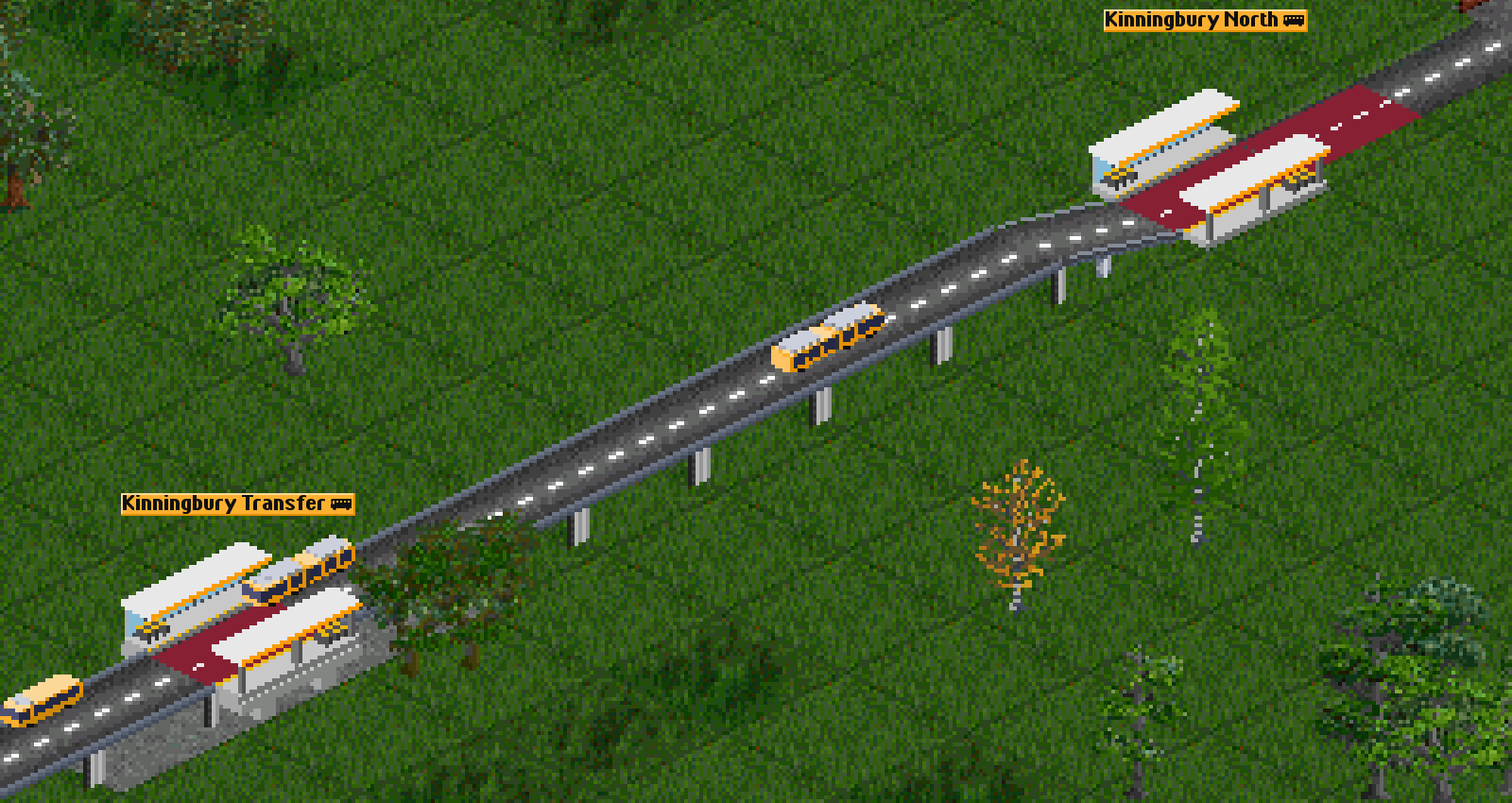
Section titled “Build an elevated busway with stations on the viaduct”OpenTTD can’t put a station on a bridge, so Wira Bandar PC raises a stop that stands between the ends of two concrete viaducts to the viaducts’ height.
- On the main toolbar, click Build roads and choose Bus-only road construction.
- Click the bridge button (B) and drag from one end of the viaduct to the other. In the Select Road Bridge window, choose Viaduct, Concrete.
- Leave one tile free after the end of the viaduct, then build a second viaduct that starts right after it and leads on. The two viaduct ends and the tile between them must be flat and at the same height.
- Build a drive-through bus stop on the tile between the two viaducts. It rises to the viaducts’ height, and the viaduct ends next to it are drawn flat, as part of the viaduct.
- Make the stop a BRT station if you like (below).
- Viaduct, Concrete is available from 1965, for roads and railways, at up to 320 km/h and as long as the Maximum bridge length setting allows. Towns don’t build it.
- Built with the bus-only road, the viaduct is an elevated busway: only buses use it, and it counts as busway for the BRT score.
- A run of up to four drive-through stops between the viaduct ends rises together.
- Buses stay at the viaduct’s height: up the first viaduct, through the station, and on without touching the ground. Land Area Information on such a stop says Stop on the viaduct: buses stay at the viaduct’s height.
- Remove one of the viaducts and the stop goes back to the ground; build it again and the stop rises again. A bridge across a raised stop is refused.
Make a stop a BRT station
Section titled “Make a stop a BRT station”- In the Bus Priority toolbar, click the BRT station button (tooltip Make a drive-through bus stop a BRT station with fare gates and level platforms), or press 6.
- Click one of your drive-through bus stops. Bay stops can’t be BRT stations (… BRT stations are built on drive-through bus stops).
- To make it an ordinary stop again, Ctrl+click it.
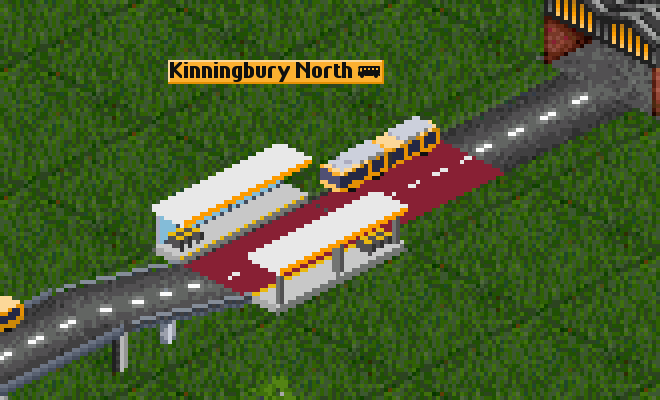
A BRT station has fare gates and level platforms, drawn as platforms with a glass wall and a roof with an edge in your company colour, in place of the stop’s shelters. Riders pay before they board and use every door, so buses load and unload twice as fast there, and the game’s own city buses, which have low floors, three times as fast (see buses). The gates are staffed, so a BRT station has a yearly upkeep; its Land Area Information shows how much. It goes with the stop.
The BRT score
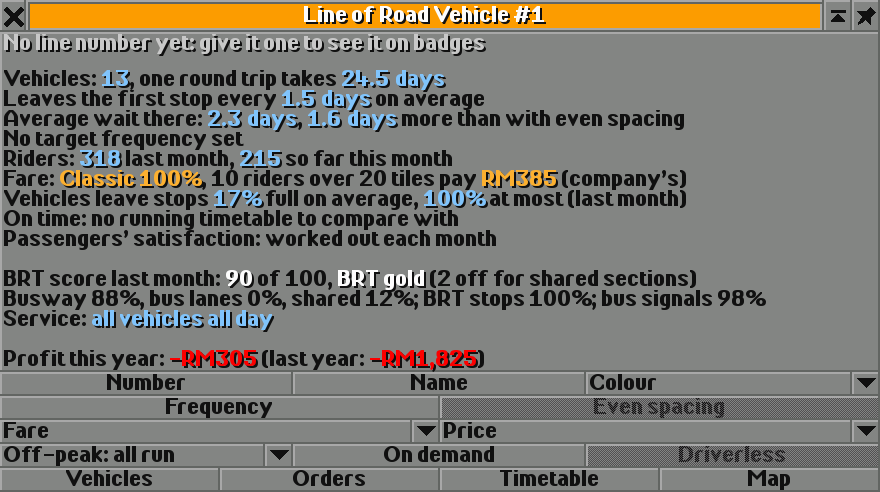
Section titled “The BRT score”Every bus line gets a BRT score from 0 to 100 each month, worked out from what its buses did the month before, after the basics of the international BRT Standard. It shows in the line window (see lines):
| Part | Points | What counts |
|---|---|---|
| Dedicated lanes | 25 | the share of the line’s distance on busways (in full), all-day bus lanes (60%) and peak bus lanes (30%) |
| Apart from the traffic | 25 | the share on busways: bus-only roads, kerbed busways, bus-only viaducts and tunnels |
| Pay before boarding | 15 | the share of stops made at BRT stations |
| Level boarding | 15 | the share of stops made at BRT stations by the game’s low-floor city buses |
| Priority at junctions | 20 | the share of junctions and level crossings crossed that have bus signals; plain traffic lights count a quarter; full points if the line crosses none |
| Shared sections | up to −30 | a point off for each percent of the distance in mixed traffic over 10% |
A line is BRT when at least half its distance is on busways or all-day bus lanes and it scores 40 or more: basic BRT from 40, BRT bronze from 55, BRT silver from 70 and BRT gold from 85. Otherwise the line window says not BRT. The second line shows the parts: Busway and bus lanes (all day) are shares of the distance, shared is the share in mixed traffic, BRT stops the share of stops at BRT stations and bus signals the share of junctions crossed that have them. Every tile a bus drives counts, including where it turns round at the ends of the line and its trips to and from the depot. A line needs to have driven at least 16 tiles and stopped at least once in a month for a score; until then the window says BRT score: worked out each month for bus lines.
What the grade gives
Section titled “What the grade gives”- Station ratings: passengers rate every station a BRT line stops at better: basic BRT +4%, bronze +7%, silver +10%, gold +14%. Where several BRT lines stop, the best one counts.
- Tenders: towns add quality points for BRT lines when they choose who runs a line: 2, 4, 7 and 10 for the four grades (see transit authorities).
In tests on one busy line through a town centre, a kerbed busway alone sped the buses up about as much as all-day bus lanes (35% more departures), and BRT stations alone added 11%. With the busway, BRT stations at both ends and bus signals at its four lit junctions, the line scored 89 (gold) and carried 17% more riders than with nothing.
- Paint the busway the whole way, including the stretch past the last stop where buses turn round, and the road to the depot. A line that loops round a block of ordinary streets at its end loses points for shared sections.
- End a line where the road ends, so buses turn round on the busway, and put the depot at an end of the busway.
- Give every lit junction the line crosses bus signals, and put traffic lights with bus signals on busy unlit junctions it crosses.
- Run the game’s own city buses (see buses) between BRT stations: that earns the level boarding points and loads three times as fast.
- The Build a BRT corridor tutorial takes a line from basic BRT to gold.
Switching it off
Section titled “Switching it off”There is nothing to switch off: busways, viaducts and BRT stations exist only where you build them. The BRT score is only shown and used for ratings and tenders; lines without busways simply score low.
See also
Section titled “See also”- Bus lanes and bus priority: lanes, give-way markings, bus signals, bus-only roads
- Lines: the line window where the score shows
- Buses: the low-floor city buses
- Interchanges and hubs: roofs over many stops at once
- Build a BRT corridor: a step-by-step example
Wira Bandar PC is a fork of OpenTTD. It is OpenTTD's code with changes, not a game made from scratch. OpenTTD is made by the OpenTTD team and contributors and is free software under theGNU General Public License version 2; Wira Bandar PC keeps that licence, OpenTTD's credits and copyright notices.Source code ·OpenTTD ·About and credits
Wira Bandar PC is not made or supported by the OpenTTD team, so please don't report its bugs to OpenTTD (see FAQ and troubleshooting).