Town transit authorities
Wira Bandar PC is a fork of OpenTTD: OpenTTD's code with changes, free software under the GNU GPL v2. About and credits
Towns of 1,500 people and more run a transit authority with a yearly budget, the way Malaysian and Singaporean cities pay for their buses. Now and then a town invites tenders for one of your lines. Win, and the town pays you a monthly fee to run it: either the town keeps the fares, as under Singapore’s Bus Contracting Model and Malaysia’s BAS.MY, or riders ride free, as on Penang’s CAT buses. Towns may also give their residents a free pass or pay back the concession fares your company gives.
Open a town’s transit authority
Section titled “Open a town’s transit authority”- Click a town’s name in the main view to open its town window (or on the main toolbar click Towns, the house icon with the tooltip Open town directory or found town, choose Town directory and click the town).
- In the bottom row of the town window, click Transit (tooltip Show the town’s transit authority: its budget, and its tenders and contracts for lines).
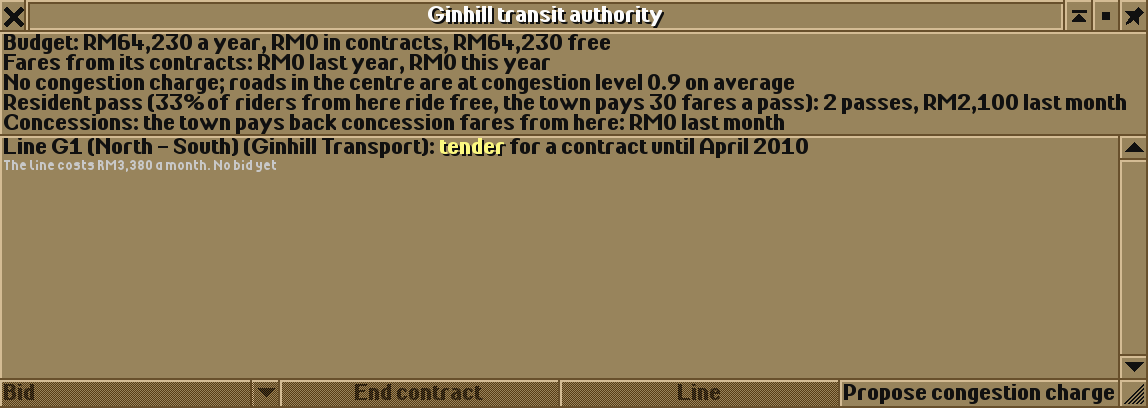
At the top the window shows the town’s budget, the fares its contracts brought in, the congestion charge and the town’s resident pass and concession refunds. Below is the list of tenders (tender, in yellow), running contracts (contract, in green) and ended ones, each with a line of details. Click one to select it. The buttons: Bid, End contract, Line (opens the line’s window) and Propose congestion charge.
The budget
Section titled “The budget”- Towns have a transit budget from 1,500 people. With Town budgets and ordinances on (the default), it is a quarter of the town’s taxes, or 40% with the Transit fund ordinance, plus a grant when the town’s state has a Transit First government (see budgets and ordinances and states and elections). With town budgets off, it is 12 bus-years for every 10,000 people, a bus-year being three times what a town bus costs to run for a year.
- Last year’s fares from the town’s contracts and its congestion charges add to what it can spend.
- Budget: … a year, … in contracts, … free: the free part is what is left after a year of the running contracts. Contracts come first; passes and concession refunds are paid from what is left.
Tenders
Section titled “Tenders”A town invites tenders now and then: with a chance of one in four each month, at least six months after its last tender, and one at a time. It picks a line that serves it, any company’s:
- at least half of the line’s stops are in the town, and it left its first stop 4 or more times that month;
- the town can afford a year of the line’s costs plus a fifth;
- the line has no tender or contract running, and had none with this town in the last two years.
Lines that lost money last year are three times as likely to be picked. About one tender in three is for a free line (riders ride free); the others are for a contract where the town keeps the fares. A news message announces it: Ginhill invites tenders to run Line G1 (North - South) under a 5-year contract (8 years with electric buses): the town keeps the fares and pays a monthly fee…. The tender stays open for 60 days.
- In the town’s Transit window, click the tender to select it.
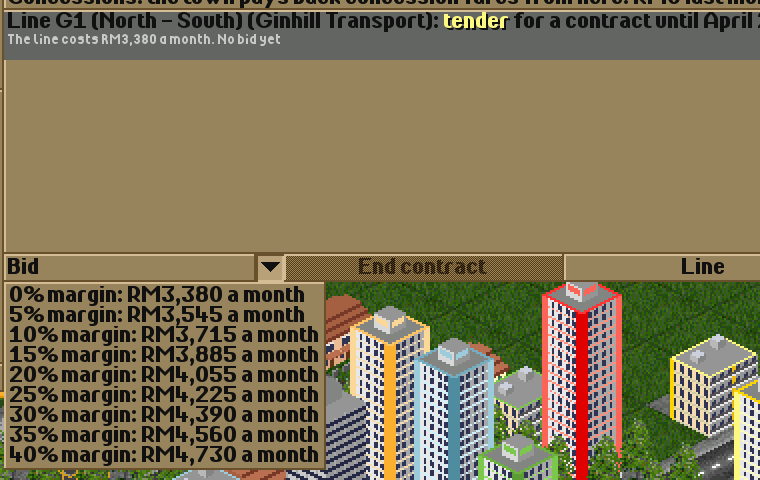
- Click Bid and choose a margin. The list goes from 0% to 40% in steps of 5%, with the monthly fee each would bring (10% margin: RM3,715 a month). Take the bid back withdraws your bid.
What the line costs is its vehicles’ running costs plus their value spread over their lifetime, per month. When the tender closes, two or three rival operators bid too, with margins of 5 to 35% and a quality of 45 to 90. The town weighs quality against price 60:40. Your quality comes from the line itself:
- regularity (40%): how close its waits are to even spacing;
- the reliability of its vehicles (30%) and their age (30%);
- up to 10 more points when it runs electric buses, and 2 to 10 for a BRT grade (see busways and BRT).
If a rival wins, the tender ends with a rival operator won the tender, and its detail line compares the bids, for example Best rival: 9% margin, quality 83. You: 10% margin, quality 58. Without a bid the tender closes with no contract. Either way the line simply runs on its own account, as before.
Contracts
Section titled “Contracts”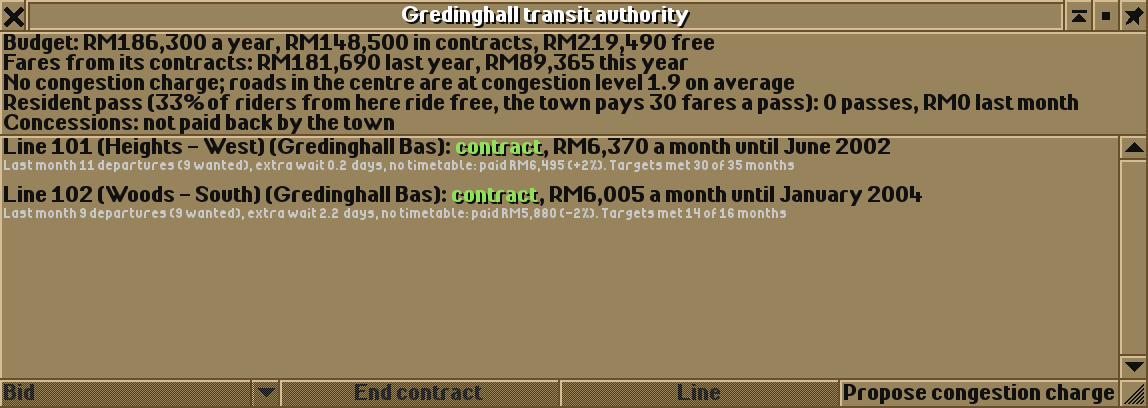
- A contract runs 5 years, or 8 when at least half of the line’s vehicles are electric buses.
- The fee is the line’s cost plus your margin. The line charges the town’s fare (a distance fare at 100%) and the fares go to the town; on a free line riders pay nothing. The line window shows Contract with … : the town keeps the fares (or free line), the fee and the end date instead of its fare.
- Each month the town pays for the departures the line made, up to the ones it asked for: 90% of the departures in the month the contract began. On top, up to 5% more or less: +2% when the excess wait at the first stop is at most nine tenths of what it was at the start, −2% when it grows well beyond; with a timetable, +3% for 85% on time or better and −3% below 70%; −2% for missed departures. The payment shows in the vehicles’ profits.
- At the end of the term, a review ends a contract that costs the town more than four standard 20-tile fares per rider. One that met every target in at least 80% of its months is extended by 3 years; the rest go back to tender.
- Two months in a row without departures end a contract. End contract ends yours early, for three months’ fees.
News messages tell you when you win, lose, are extended or a contract ends. Ended contracts stay in the list for a year.
Resident passes and concession refunds
Section titled “Resident passes and concession refunds”When a town reaches 1,500 people it decides once, at the end of a month:
- Resident pass: four towns in ten give their residents a free pass, like Penang’s Pas Mutiara. A third of the riders who board in the town ride free on every operator’s lines there (not on contracted lines). The town pays each operator 30 standard 20-tile fares a month for each pass, a pass being 40 trips.
- Concessions: half of the towns pay back concession fares: where your company gives students, seniors and disabled riders a half or free fare (see fares), the town pays back what they didn’t pay on journeys from the town.
Both come from what is left of the budget after contracts. When it runs out, they are paid only in part until the new year, and a news message says so. The window shows what the town paid last month.
Feeder buses and congestion charges
Section titled “Feeder buses and congestion charges”Towns with a railway station sometimes ask for a feeder bus to it and pay the first company that runs one: see metro and rail. Propose congestion charge is explained under expressways and tolls.
- Make a line regular before its tender closes: a target frequency with even spacing (see lines) raises your quality more than a low margin does.
- Electric buses help twice: more quality points and an 8-year term.
- A contract pays steadily whatever the riders; on a busy, profitable line a low margin may earn less than the fares did. On a line that loses money, it is the town’s money that saves it.
- Keep the departures up: every missed departure cuts the month’s fee.
Switching it off
Section titled “Switching it off”There is nothing to switch off. If you never bid, your lines run on their own account as in OpenTTD. Resident passes and concession refunds are the towns’ own decisions: a pass lets some riders ride free, and the town pays you for it.
See also
Section titled “See also”- Lines: regularity, even spacing and the line window
- Fares: concessions and the fares contracts replace
- Budgets and ordinances: where the town’s transit money comes from
- Modern and electric buses: electric buses for longer contracts
- Your first city bus network: a town’s first tender
Wira Bandar PC is a fork of OpenTTD. It is OpenTTD's code with changes, not a game made from scratch. OpenTTD is made by the OpenTTD team and contributors and is free software under theGNU General Public License version 2; Wira Bandar PC keeps that licence, OpenTTD's credits and copyright notices.Source code ·OpenTTD ·About and credits
Wira Bandar PC is not made or supported by the OpenTTD team, so please don't report its bugs to OpenTTD (see FAQ and troubleshooting).