
Fares
Wira Bandar PC is a fork of OpenTTD: OpenTTD's code with changes, free software under the GNU GPL v2. About and credits
In OpenTTD a passenger’s payment is fixed by the distance and the speed of the trip. In Wira Bandar PC you decide how your company charges riders: a distance fare like Malaysia’s BAS.MY buses, a flat fare, zones, or nothing at all, at a price level you choose, with cheaper fares for students and seniors and monthly passes. Fares change your income and also how many people ride: riders weigh what they pay, and cheap fares make passengers rate your stations better.
Set your fares
Section titled “Set your fares”- On the main toolbar, click Finances (the money icon; tooltip Open company finances information).
- In the bottom row of the Finances window, click Fares (after Infrastructure). The fares window opens, titled with your company’s name and Passenger fares.
- In the row of a transport type (Buses, Trams, Trains, Ships or Aircraft), click the value you want to change under Fare, Price, Concessions or Monthly pass, and pick from the list.
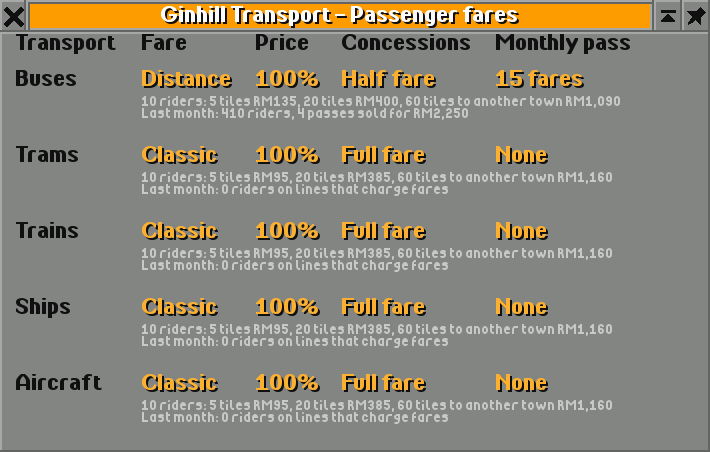
Under each transport type the window shows what 10 riders pay for a trip of 5 tiles, 20 tiles, and 60 tiles to another town, so you can compare schemes at a glance, and last month’s riders on lines that charge fares (and the passes sold).
Fare schemes
Section titled “Fare schemes”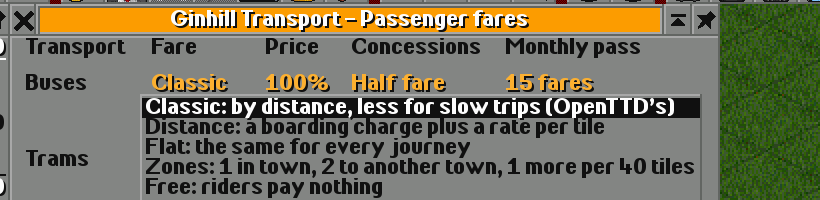
| Fare | What a journey costs |
|---|---|
| Classic | OpenTTD’s own payment: by distance, less for slow trips. |
| Distance | A boarding charge (what 3 tiles cost) plus 90% of the standard rate for each tile, however long the trip takes. |
| Flat | What 20 tiles cost, for every journey. |
| Zones | What 16 tiles cost, for each zone: 1 zone within a town, 2 to another town, and 1 more for every 40 tiles. |
| Free | Nothing. |
The standard fare is OpenTTD’s payment for a trip that takes no time. Price scales the scheme from 25% to 300% (25, 50, 75, 100, 125, 150, 175, 200, 250 or 300%).
Concessions: a fifth of riders are students, seniors and disabled riders. They pay the Full fare, a Half fare, or ride Free. Some towns pay back what they don’t pay (see transit authorities).
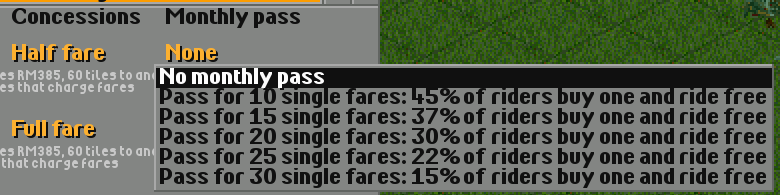
Monthly pass: None, or a pass that costs 10, 15, 20, 25 or 30 single fares. The cheaper the pass, the more riders buy one: 45%, 37%, 30%, 22% or 15% of them. Pass holders ride free. At the end of each month, passes are sold to that share of the month’s riders, one pass for every 40 trips, and the money comes in as income.
How fares are paid
Section titled “How fares are paid”- A journey pays one fare. When passengers reach their destination, they pay the fare for the whole trip from where they first boarded, however often they changed on the way. Transfer credits use the same fare.
- A vehicle charges its company’s fare for its transport type, unless its line has its own (below).
- The defaults (Classic, 100%, Full fare, no pass) pay exactly as OpenTTD does.
- A line under contract with a town charges the town’s fare: a distance fare at 100%, and the fares go to the town; a free line charges nothing (see transit authorities).
- In towns that give their residents a free pass, a third of the riders who board there ride free on your lines, and the town pays you for the passes instead.
Give one line its own fare
Section titled “Give one line its own fare”- Open the line window (see lines).
- Click Fare and pick a scheme for this line only, or Company’s fare to go back to your company’s.
- Click Price for its own price level, or Company’s price.
The line window then shows the line’s fare, for example Fare: Classic 100%, 10 riders over 20 tiles pay RM385 (company’s), with (this line’s) when the line has its own. While a line is under contract, Fare and Price are greyed out.
How riders react
Section titled “How riders react”Each station keeps what the riders who boarded there paid, against what OpenTTD’s classic fare would have been, month by month. For every 3% below the classic fare, its passenger rating goes up 4 points (of 255), up to 23% better; for every 3% above, it goes down as much, down to 58% worse. The station window’s ratings view (Ratings in its bottom row) says how it stands.
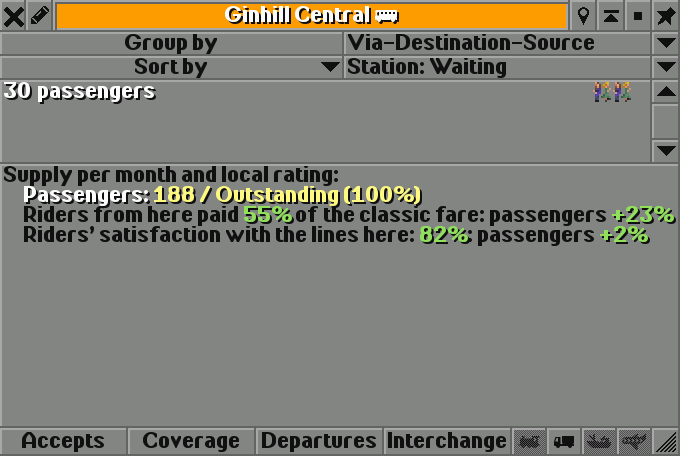
Concessions, passes and resident passes all lower what riders pay, so they help the rating too. Better ratings mean more passengers at the station, so the price that earns most is a little above the classic fare: about 120%, as the window’s tooltip says. A test with two town lines of 12 buses each (averages over a year):
| Bus fares | Riders a month | Passenger rating | Income (classic 100% = 100) |
|---|---|---|---|
| Classic 100% | 436 | 70% | 100 |
| Classic 50% | 491 | 94% | 56 |
| Classic 125% | 362 | 58% | 104 |
| Classic 150% | 271 | 44% | 93 |
| Classic 200% | 87 | 17% | 37 |
| Flat 100% | 394 | 64% | 101 |
| Distance 100% | 416 | 67% | 101 |
| Zones 100% | 456 | 76% | 94 |
| Free | 491 | 94% | 0 |
| Pass for 20 fares, half-fare concessions | 500 | 90% | 90 |
The price level also counts for passenger satisfaction: its fares part is 100 for free rides or half the standard fare, 75 at the standard fare, and a point less for every 2% dearer.
- Change one thing at a time and give it a month or two: ratings and riders follow what riders paid last month.
- Flat and zone fares charge short trips much more than the classic fare and long trips less. A distance fare adds a boarding charge, so short trips cost a little more and long ones a little less. The example line under each row shows the difference.
- Before you give concessions, check the town’s Transit window: if the town pays back concession fares, half or free concessions cost you little or nothing while its budget lasts.
- A line in a town with poor ratings can have a lower price of its own without cutting fares everywhere.
Switching it off
Section titled “Switching it off”There is nothing to switch off: with the default fares (Classic, 100%, Full fare, no monthly pass) passengers pay exactly as in OpenTTD.
See also
Section titled “See also”- Lines: the line window where a line’s own fare is set
- Town transit authorities: contracts, free lines, resident passes and concession refunds
- Passenger satisfaction: the fares part of riders’ satisfaction
- Your first city bus network: fares in a first game
Wira Bandar PC is a fork of OpenTTD. It is OpenTTD's code with changes, not a game made from scratch. OpenTTD is made by the OpenTTD team and contributors and is free software under theGNU General Public License version 2; Wira Bandar PC keeps that licence, OpenTTD's credits and copyright notices.Source code ·OpenTTD ·About and credits
Wira Bandar PC is not made or supported by the OpenTTD team, so please don't report its bugs to OpenTTD (see FAQ and troubleshooting).